A trade can make money for the wrong reasons or lose money despite following a sound process. That is why traders need to Analyze Winning and Losing Trades separately instead of judging every position only by its final profit or loss. Looking at each outcome on its own can reveal different patterns in execution, timing, market conditions, and decision-making.
Winning trades can show which parts of a strategy are producing favorable results, while losing trades can expose weaknesses that need attention. Separating the two gives traders a clearer way to review your trades without allowing a single profitable or unprofitable outcome to define the quality of the entire approach.
In this blog, we will explore what winning and losing trades reveal, how they differ, and five practical steps for reviewing both types separately. We will also look at how a trading journal and structured trade analysis can turn individual results into useful performance insights.
What Does Winning and Losing Trades Mean?
Winning trades are positions that close with a positive financial result after considering relevant costs. Losing trades close below the entry value after accounting for those costs. However, the result alone does not explain whether the trade was well executed.
A profitable position may have involved poor risk control, while a losing position may have followed the intended setup correctly. This distinction makes the review process more useful than simply counting wins and losses.
What Winning Trades Can Reveal
A winning trade provides evidence about what happened when the position moved in the desired direction. It should be examined for the conditions that supported the result rather than treated as automatic proof that every decision was correct.
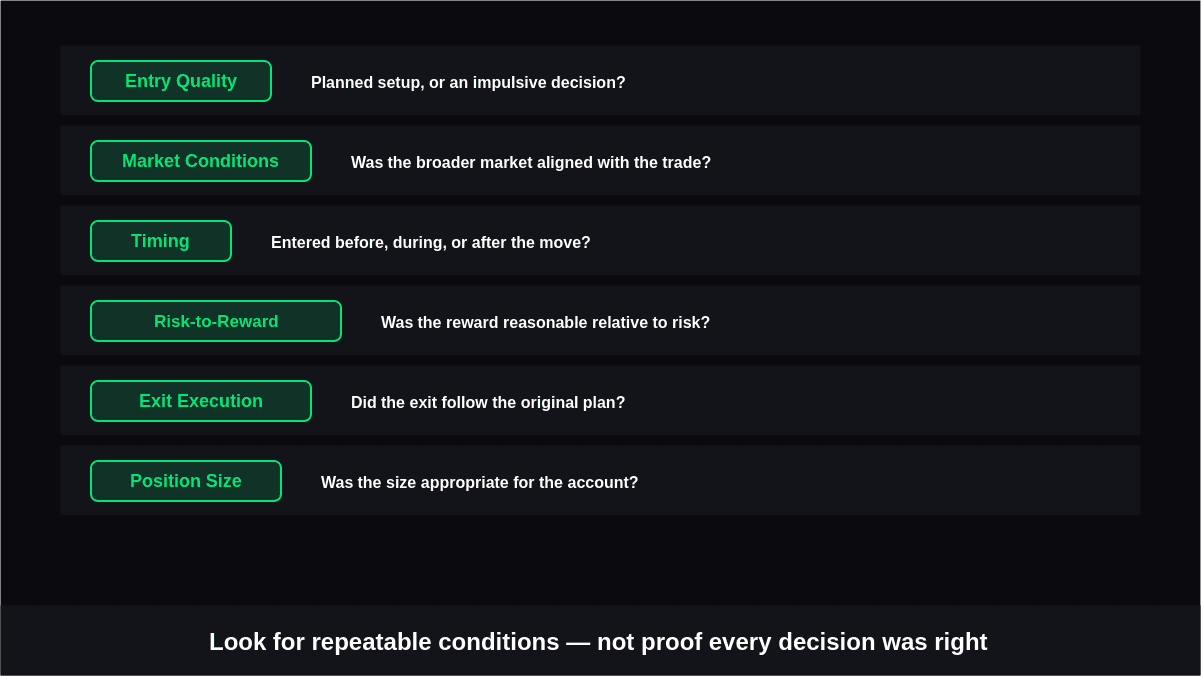
When reviewing winning trades, consider:
- Entry quality: Was the entry based on the planned setup or an impulsive decision?
- Market conditions: Was the broader market aligned with the trade?
- Timing: Did the position enter before, during, or after the important price movement?
- Risk-to-reward structure: Was the potential reward reasonable relative to the amount at risk?
- Exit execution: Did the exit follow the original plan?
- Position size: Was the size appropriate for the account and setup?
- Trade management: Were stops, targets, or adjustments handled according to predetermined rules?
The goal is to identify repeatable characteristics rather than assume every profitable decision should be copied.
What Losing Trades Can Reveal
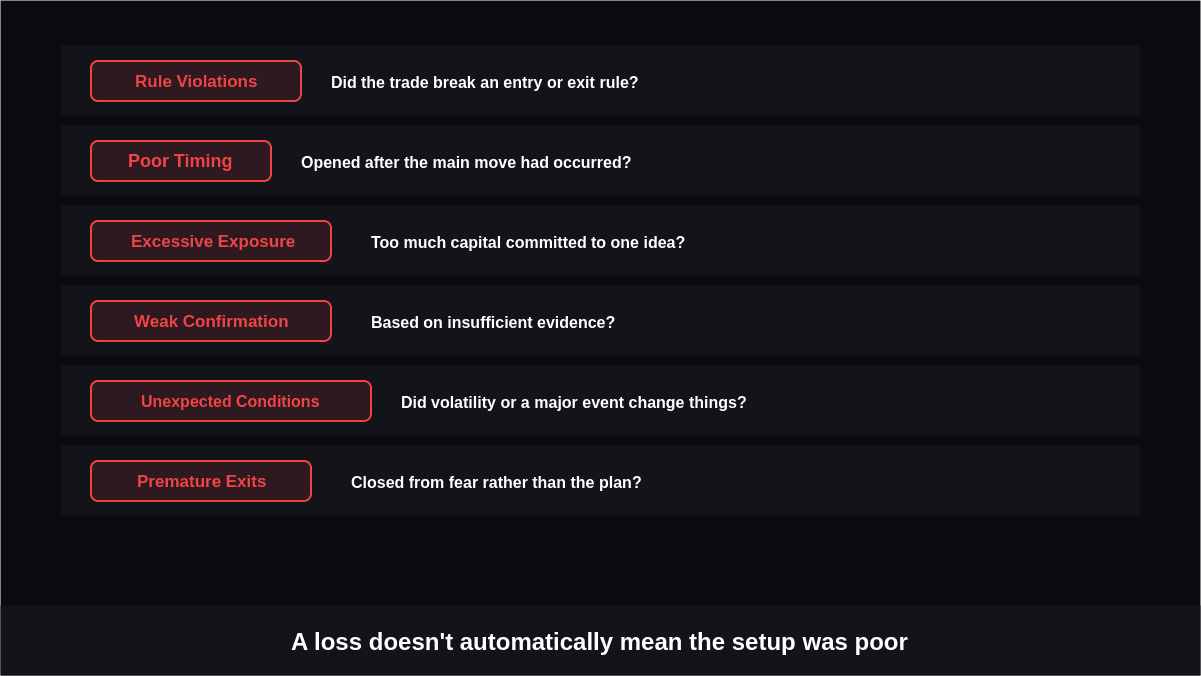
A losing trade can provide information about either the trading process or the limits of the strategy. A loss does not automatically mean the setup was poor. Markets can move against a valid position even when the analysis and execution are consistent.
When examining losing trades, look for:
- Rule violations: Did the trade break an established entry or exit rule?
- Poor timing: Was the position opened after the main move had already occurred?
- Excessive exposure: Was too much capital committed to one idea?
- Weak confirmation: Was the trade based on insufficient evidence?
- Unexpected market conditions: Did volatility or a major event change the environment?
- Premature exits: Was the position closed because of fear rather than the trading plan?
- Recurring patterns: Does the same type of mistake appear across several losing positions?
This helps distinguish an unavoidable market loss from a preventable execution problem.
Winning vs Losing Trades: 7 Key Differences
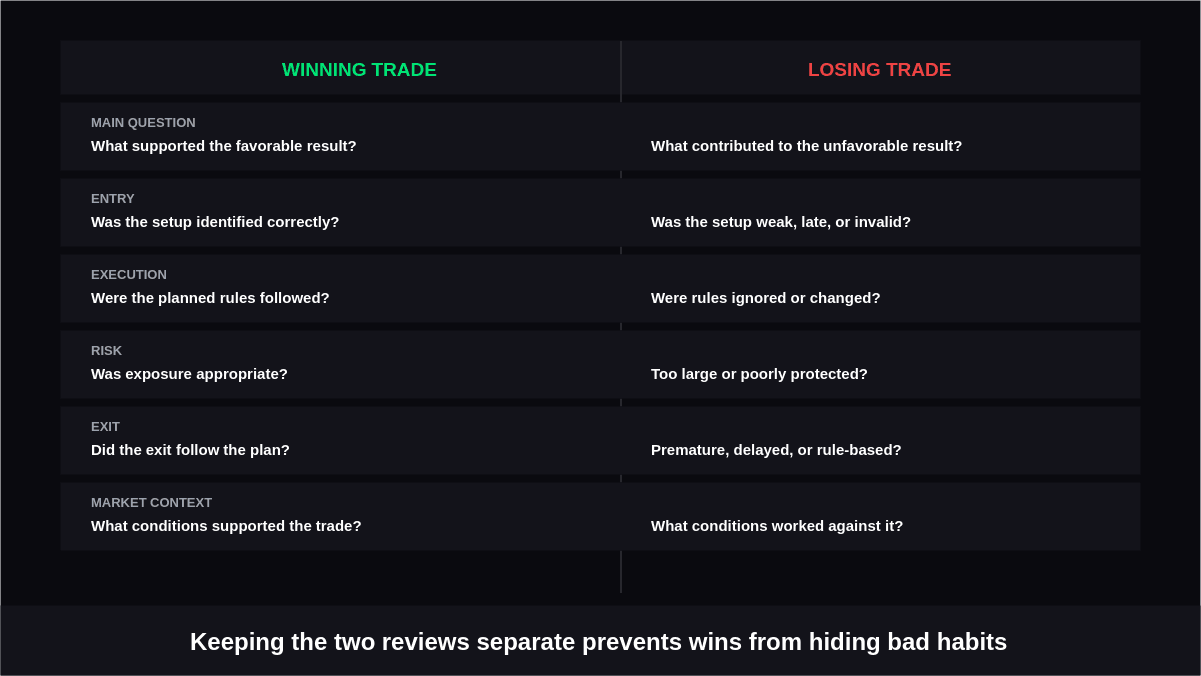
Winning and losing positions should not be treated as identical data points because they can answer different questions about a trading process.
A winning trade can reveal conditions associated with favorable outcomes, while a losing trade can expose weaknesses, uncertainty, or situations where the strategy performs differently.
| Review Area | Winning Trade | Losing Trade |
|---|---|---|
| Main question | What supported the favorable result? | What contributed to the unfavorable result? |
| Entry | Was the setup identified correctly? | Was the setup weak, late, or invalid? |
| Execution | Were the planned rules followed? | Were rules ignored or changed? |
| Risk | Was exposure appropriate? | Was the position too large or poorly protected? |
| Exit | Did the exit follow the plan? | Was the exit premature, delayed, or rule-based? |
| Market context | What conditions supported the trade? | What conditions worked against it? |
| Improvement | Which behaviors may be repeatable? | Which problems may need correction? |
Reviewing both sides together eventually provides a more complete picture. However, keeping their initial evaluations separate prevents profitable outcomes from hiding poor habits and prevents normal losses from being mistaken for strategy failure.
5 Steps to Analyze Winning and Losing Trades Separately
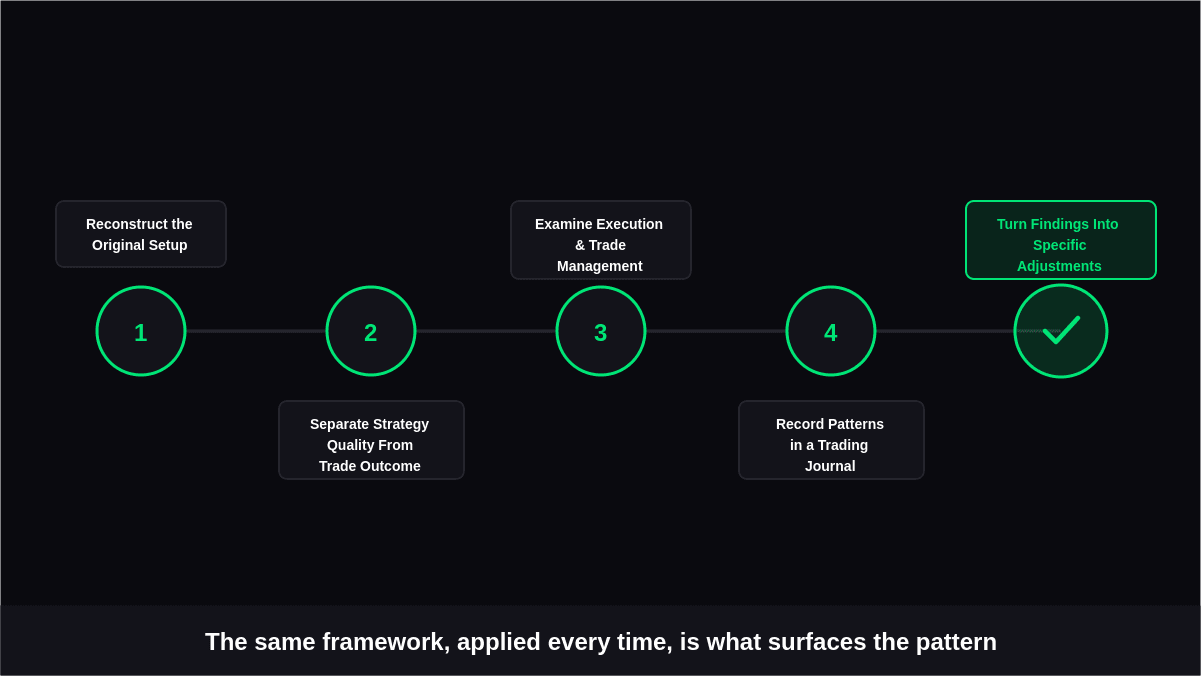
Effective trade analysis works best when every position is reviewed using the same framework. This makes it easier to identify patterns instead of relying on memory or emotion.
The following five steps provide a practical process for evaluating winning and losing trades independently.
1. Reconstruct the Original Trade Setup
Start by recording what the trade looked like before the outcome was known. This prevents hindsight from changing the original reasoning.
For each position, document:
- Entry price and time
- Planned stop and target
- Market or asset traded
- Timeframe used
- Reason for entering
- Relevant technical or fundamental conditions
- Expected risk and potential reward
For winning trades, determine whether the original setup genuinely supported the position. For losing trades, check whether the setup met the required conditions before the trade was opened.
2. Separate Strategy Quality From Trade Outcome
The next step is to determine whether the result accurately reflects the quality of the decision.
A winning trade can still be poorly executed. For example, a trader might enter without confirmation, use excessive leverage, and happen to benefit from a sudden price move. The profit does not necessarily make those choices sound.
Likewise, a losing trade can follow the strategy correctly. If the entry, position size, stop placement, and exit rules were all consistent with the plan, the loss may simply represent normal uncertainty.
This distinction helps prevent outcome-based thinking from distorting the review.
3. Examine Execution and Trade Management
Once the setup has been reviewed, focus on what happened after the position was opened.
For winning positions, examine whether the trader managed the position according to the original plan or changed decisions because the trade became profitable. For losing positions, determine whether adjustments helped contain the loss or made the situation worse.
Check:
- Whether the stop was moved
- Whether the position was scaled in or out
- Whether the target was changed
- Whether an exit was delayed
- Whether emotions affected the decision
- Whether the original plan remained intact
This step is particularly useful because two trades with similar setups can produce very different outcomes due to execution.
4. Record Patterns in a Trading Journal
A trading journal should do more than record profit and loss. It should preserve enough information to compare groups of trades over time.
Create separate categories for winning and losing positions, then record measurable characteristics such as:
- Setup type
- Time of entry
- Holding period
- Market condition
- Risk-to-reward ratio
- Exit reason
- Rule violations
- Maximum favorable movement
- Maximum adverse movement
After collecting enough trades, review the categories for recurring behavior. You may discover that certain setups perform differently during specific market conditions or that particular execution mistakes appear disproportionately often in losing trades.
5. Turn Findings Into Specific Adjustments
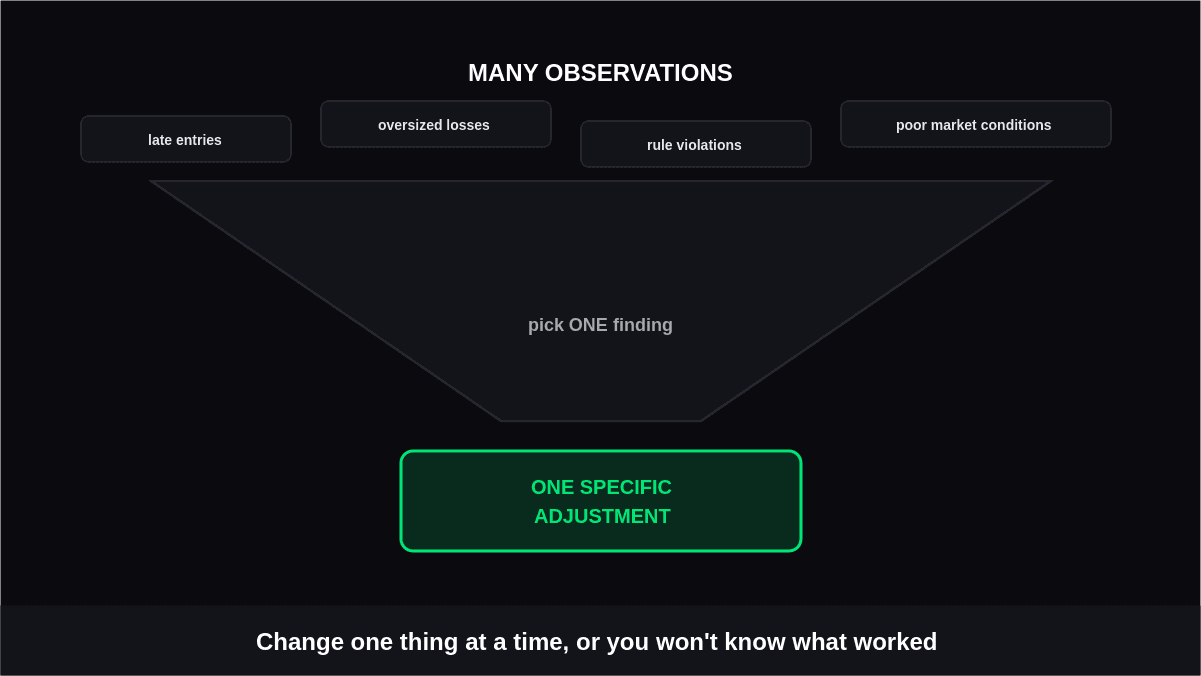
The final step is converting observations into controlled improvements. Avoid changing several parts of a strategy at once because it becomes difficult to determine which adjustment produced the change.
Instead, identify one actionable finding.
For example:
- If losing trades frequently come from late entries, define a clearer entry condition.
- If winning trades often reach the initial target, avoid changing targets without a specific reason.
- If position size contributes to oversized losses, review risk management rules.
- If certain market conditions repeatedly produce poor results, create a separate category for those conditions.
- If rule violations appear frequently, track them independently from strategy-generated losses.
The objective is not to eliminate every losing trade. It is to make future decisions more consistent with the evidence collected from previous trades.
Conclusion
Learning to Analyze Winning and Losing Trades separately gives traders a more useful view of performance than simply calculating a win rate.
Winning positions can reveal favorable conditions and repeatable execution behaviors, while losing positions can identify weaknesses, unavoidable uncertainty, or situations where a strategy may need further testing.
A structured review process also makes trade analysis more objective. By reconstructing the setup, separating decision quality from outcome, reviewing execution, maintaining a trading journal, and making measured adjustments, traders can turn individual results into practical information, and analyzing the backtest results can provide another framework for evaluating performance.
Over time, this approach can support more disciplined decision-making and more consistent risk management.