Apex Trader Funding works differently now compared to its older funding and evaluation programs. In the current year 2026, there is a one-off Evaluation fee for 30 days instead of monthly subscription and resets. There are two main types of evaluations available which include intraday and end of day evaluations with distinct approaches to managing drawdowns.
That distinction matters when interpreting older performance simulations. The older Apex model had a $167 monthly fee, $80 resets, a 30% consistency rule, and a $50,100 evaluation trail lock. These rules are not part of the current product structure.
The historical simulation can still illustrate how different risk rules affect trader outcomes, but its assumptions should not be confused with today's live requirements.
In this blog you will explore everything that you need to know related to Apex Trader Funding including the rules, risks and payout odds.
What Is Apex Trader Funding?
Apex Trader Funding is a prop trading firm that gives traders the opportunity to trade through its programs. Traders need to follow the rules of the program they choose and meet its requirements. The goal is to manage the account properly and qualify for potential payouts.
- Offers different trading programs for traders.
- Requires traders to follow specific account rules.
- Provides payout opportunities for eligible traders.
The exact rules and program features can change over time. For this reason, traders should check the current program details before starting.
Apex Trader Funding Structure at a Glance
You can find the current analyses in both the Intraday and EOD versions. An analysis of 50K has a target gain of $3,000 in both cases, but the method of calculating drawdown is vastly different.
| Feature | Intraday Evaluation | EOD Evaluation |
|---|---|---|
| 50K profit target | $3,000 | $3,000 |
| Maximum drawdown | $2,000 | $2,000 |
| Drawdown method | Real-time trailing | Calculated at market close |
| Unrealized gains affect drawdown | Yes | No, for the EOD calculation |
| Daily Loss Limit | None | $1,000 |
| Minimum trading days | None | None |
| Access period | 30 calendar days | 30 calendar days |
| Evaluation consistency | Not applied | Not applied |
| Position size | Fixed during evaluation | Fixed during evaluation |
| Passing in one day | Yes | Yes |
Intraday vs EOD Evaluations: What's the Difference?
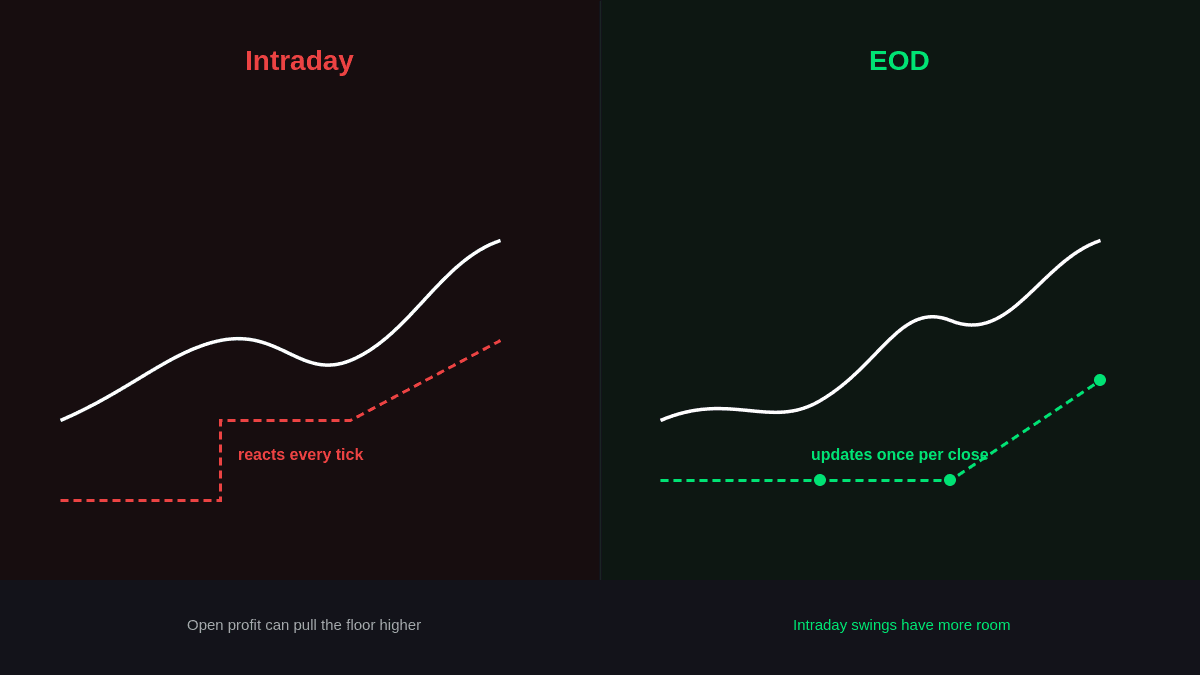
Intraday and EOD are not just different platform options. They also handle short-term price changes differently, so the choice can affect how you trade. Intraday evaluations operate under a threshold that trails and may change based on unrealized gains, and therefore are more vulnerable to reversal.
Understanding these differences can help traders choose the structure that better fits their risk management approach.
| Feature | Intraday Evaluation | EOD Evaluation |
|---|---|---|
| Drawdown | Updates instantly at peak equity. | Updates only at market close. |
| Unrealized Profit | Can permanently pull your drawdown floor up. | Ignored for the drawdown floor until closed. |
| Intraday Retracement | More sensitive to open-profit reversals | More room for intraday fluctuations |
| Best Suited For | Scalpers taking quick, realized targets. | Swing traders holding through pullbacks. |
Intraday Drawdown Rules
The Intraday model uses a real-time trailing drawdown. The threshold can move higher when the account reaches a new peak equity, including unrealized gains.
For a current 50K Intraday Evaluation:
- Maximum drawdown is $2,000.
- The threshold trails higher as the account reaches new highs.
- On Intraday Performance Accounts, the trailing threshold ultimately locks near the starting balance (commonly described as start + ~$100); evaluation trailing behavior is simply ‘peak equity’ without a fixed cap stated in current summaries.
The Performance Account works differently. For a 50K Intraday PA, the trailing threshold ultimately stops at $50,100.
The main risk is that:
- Open profits can raise the trailing threshold.
- A later reversal can reduce the trader’s available buffer.
- Unrealized profits can therefore increase drawdown pressure.
Because of this, traders testing an Intraday strategy should look at maximum intraday equity drawdown, not just closed-trade losses.
EOD Drawdown Rules
The EOD model handles drawdown differently. Instead of continuously adjusting the threshold based on every new intraday equity high, the drawdown calculation is based on the account's end-of-day balance.
The resulting threshold is then used for the following trading session. This gives traders more room for normal intraday fluctuations because temporary unrealized gains do not continuously push the drawdown threshold higher during the session.
However, the EOD model also has a Daily Loss Limit (DLL). For the current 50K EOD Evaluation, the Daily Loss Limit is $1,000.
This means EOD traders need to manage two separate constraints:
- The account's EOD drawdown threshold.
- The Daily Loss Limit during the trading session.
A strategy can therefore remain above its overall drawdown threshold but still encounter a problem if its daily losses exceed the applicable DLL.
The same general distinction continues into the Performance Account, where the EOD threshold ultimately stops at the applicable PA floor. For a 50K EOD PA, the applicable PA floor is $50,100.
After the EOD threshold is calculated at market close, it is enforced during the following session; if the account balance (including unrealized P&L on PAs) touches the threshold intraday, the account can be liquidated and closed.
Why the Two Drawdown Models Create Different Risks
The biggest difference between Intraday and EOD is when the account's risk buffer can change. To understand better follow the below table:
| Risk factor | Intraday | EOD |
|---|---|---|
| Threshold movement | Can change during the session | Based on EOD calculation |
| Unrealized gains | Can affect the trailing threshold | Do not continuously move the threshold |
| Open-profit reversal | Higher sensitivity | Lower sensitivity to intraday peak equity |
| Daily Loss Limit | Not applicable in the evaluation | Applies |
| Main risk | Trailing threshold can tighten after new equity highs | DLL can restrict intraday losses |
| Strategy testing focus | Intraday equity excursions | EOD drawdown + daily loss behavior |
Therefore, traders should not compare Intraday and EOD accounts using profit targets alone. The more useful comparison is how the strategy behaves against each model's specific drawdown mechanics.
What Happened to the Old Subscription and Reset Model?
The old subscription model was part of Apex’s Legacy products, which are no longer available.The new evaluations are paid for once and provide access for 30 calendar days. No recurring subscription or reset fees apply under the current evaluation structure. If the evaluation expires or is failed, the trader must purchase a new evaluation to continue.
This changes how evaluation costs should be analyzed.
- A trader should no longer calculate expected costs using an assumed monthly rebill or $80 reset.
- The relevant calculation is how many separate evaluation purchases may be required before successfully passing and moving to a Performance Account.
Also, this 30-day period is measured in calendar days and not trading days. The weekends and holidays are included in the access period.
What Happens After You Pass the Evaluation?
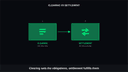
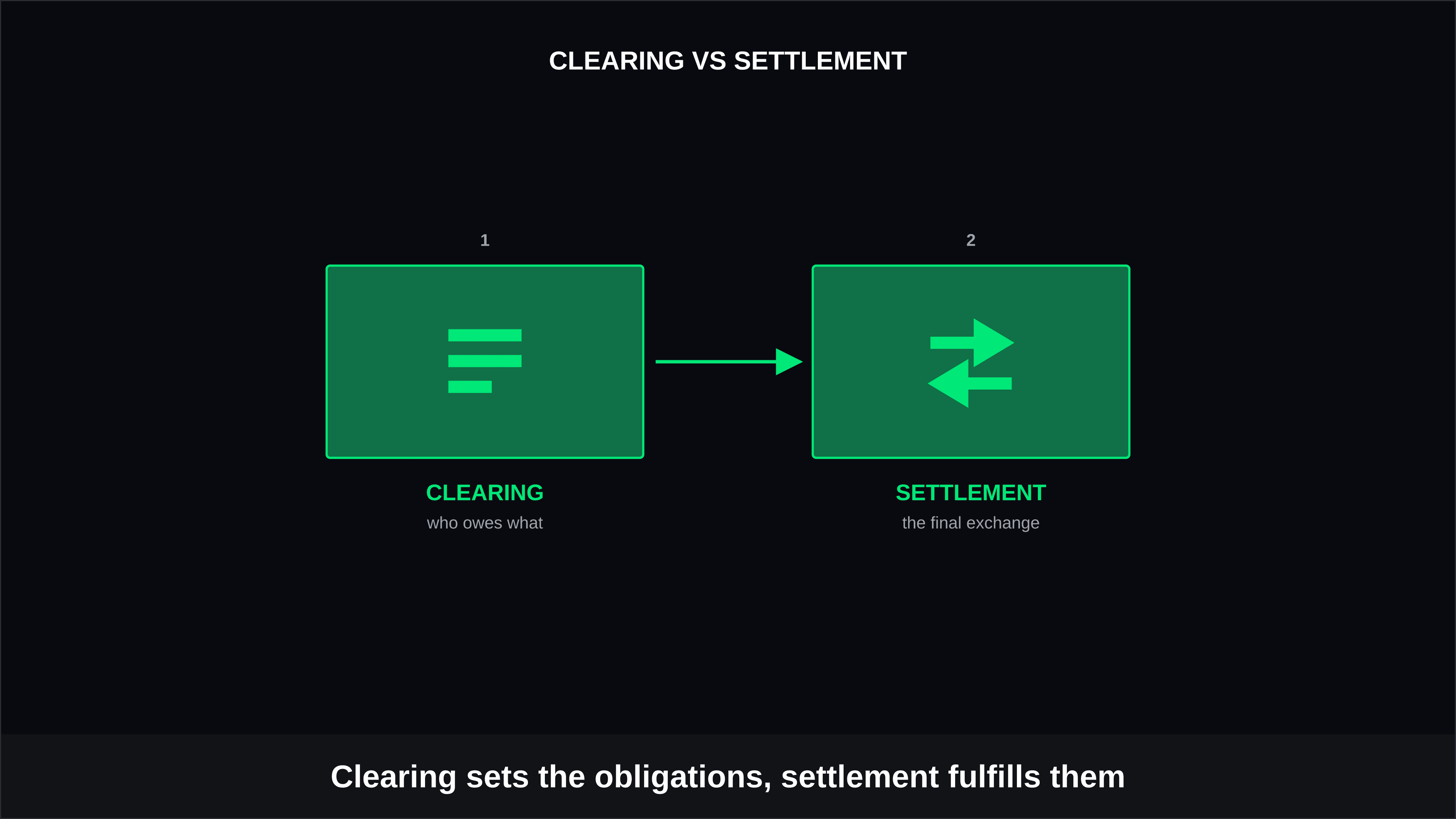
Once you pass the evaluation, your account moves into the Performance Account (PA) stage. This changes the focus from proving that you can meet the evaluation target to building a trading record that qualifies for withdrawals.
The Performance Account gives you the opportunity to trade under the PA rules, but profits are not immediately available for withdrawal. You need to establish the required trading history and follow the account’s risk and consistency conditions.
Your evaluation strategy may continue to work in the PA, but it should be adjusted to account for the different withdrawal rules. Traders should also avoid increasing risk simply because they have successfully passed the evaluation.
The specific conditions for becoming payout-eligible are covered in the Performance Account Payout Requirements section below.
Performance Account Payout Requirements
Passing the evaluation is only the first step. Once you enter a Performance Account, you must meet the payout requirements before withdrawing profits.
- 5 qualifying trading days
- $500 minimum payout
- 50% consistency rule applies
- Daily profit requirements vary by account type.
- A permanent safety net (drawdown limit + $100 above starting balance) applies; only profit above this floor is eligible for payout, and the minimum balance to request already includes this requirement.
For a 50K PA, the minimum daily profit is $200 for Intraday and $250 for EOD. The five qualifying days do not need to be consecutive.
These figures reflect commonly published 2026 tables; confirm exact qualifying‑day minimums in your PA dashboard.
These requirements mean passing the evaluation does not automatically make a trader eligible for a payout.
Current Rules vs. the Older Simulation
The biggest lesson from the original dataset is not that its figures are unusable. It is that rule-sensitive simulations need to be updated whenever the account structure changes.
| Item | Older simulation | Current 2026 structure |
|---|---|---|
| Evaluation payment | $167 monthly | One-time fee |
| Evaluation access | Subscription model | 30 calendar days |
| Reset | $80 modeled reset | No reset fee; new evaluation required |
| Evaluation consistency | None | None |
| Funded consistency | 30% | 50% |
| Evaluation trail | $50,100 in model | Rithmic/Wealthcharts Intraday stops at $53,000 threshold |
| PA threshold | $50,100 | $50,100 for Intraday/EOD PA |
| Drawdown choice | Intraday only | Intraday or EOD |
| EOD Daily Loss Limit | Not modeled | Applies to EOD accounts |
The current rules are documented by Apex, while the older figures remain outputs of the supplied simulation.
Older community simulations sometimes reference a 30% consistency rule; current official documentation emphasizes no evaluation consistency and a 50% consistency rule at the PA payout stage.
How the 50% Consistency Rule Works
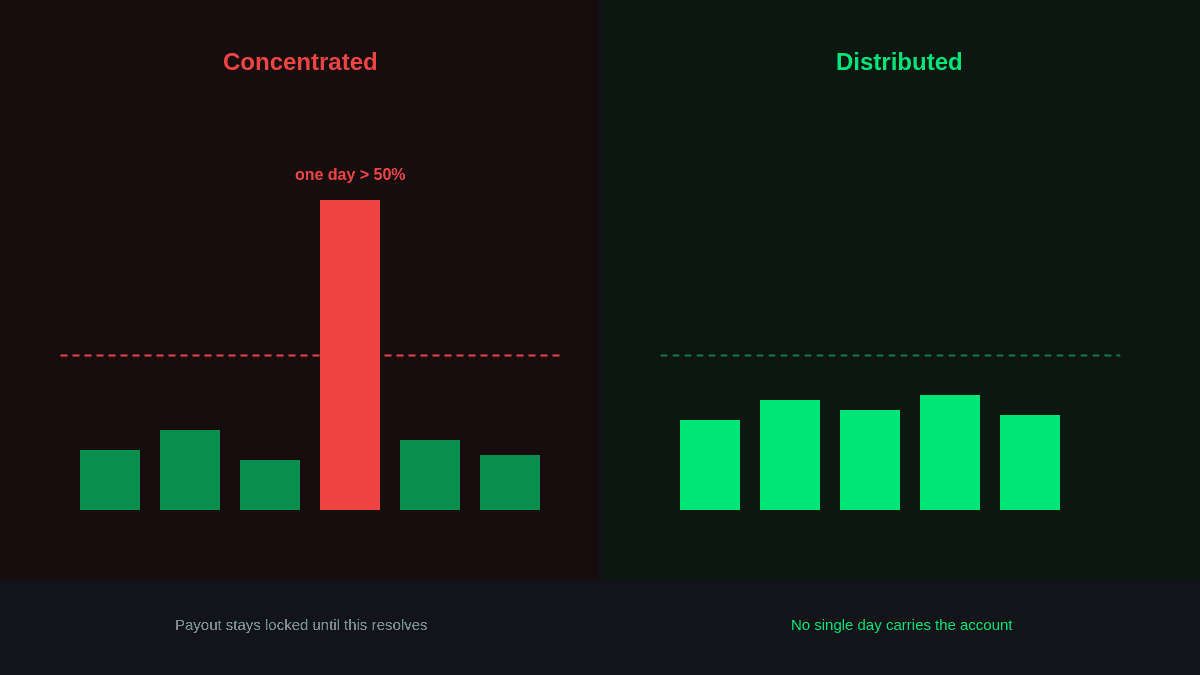
Under the current funded-stage rules, a trader's largest profitable day must represent less than 50% of total net profit during the applicable payout period. If the largest day represents 50% or more, the trader must generate additional profit until the percentage falls below 50%.
For example, if the largest profitable day is $1,500, total accumulated profit must exceed $3,000 for that day to represent less than 50% of total profit.
This calculation means profits cannot be overly concentrated in a single trading day.
Historical Simulation Results and Payout Probability
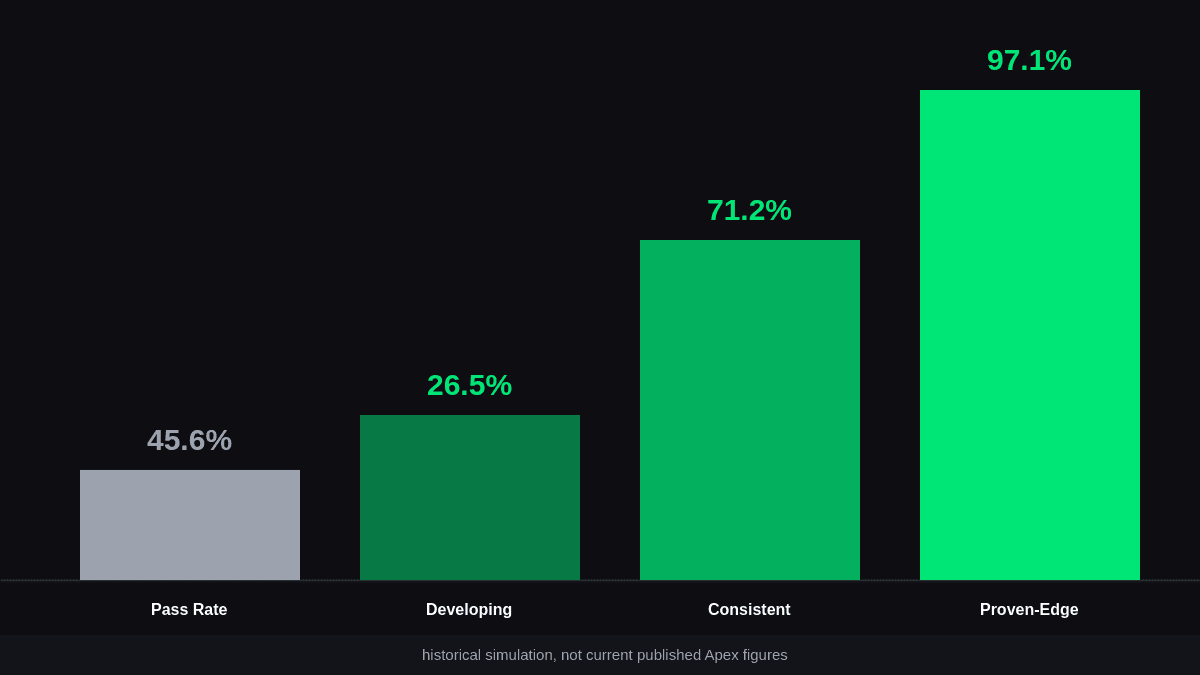
The original dataset used older prices and rule assumptions and produced a 45.6% simulated evaluation pass rate for its developing trader profile. It also estimated payout probabilities of 26.5% for developing traders, 71.2% for consistent traders, and 97.1% for a proven-edge profile.
These figures should be treated as historical simulation results, not as current Apex pass or payout rates. Their value is in showing that the probability of passing an evaluation and the probability of eventually reaching a payout are separate measurements.
A trader evaluating these probabilities should first validate trading strategies against the rules that actually apply to the account being considered.
How to Validate a Trading Strategy Against Prop Firm Rules
A backtest should evaluate more than total profit. A strategy that produces large gains quickly may behave very differently under the Intraday trailing model than under the EOD model.
Useful measurements include:
- Maximum drawdown, intraday equity excursions, and losing streaks to assess risk and recovery behavior.
- Average winning-day size, largest profitable day, and each day's contribution to total profit to identify whether results depend too heavily on a few unusually strong sessions.
Understanding backtesting metrics can help separate a strategy's historical edge from assumptions that may not survive different market conditions.
Traders can also evaluate non repainting buy sell indicator behavior, compare technical analysis on leading vs lagging indicators, and assess how multiple trading indicators interact before assuming that additional signals improve a system.
The objective should be to understand the strategy's behavior under the account's constraints, not simply to find the highest historical return.
The Role of Trading Psychology
Rules can affect behavior just as much as they affect account math.
The trader, who has watched the position run powerfully into profit, may find himself hesitant to close out the position as it has not yet achieved its goal profit target. With the Intraday Trailing approach, though, each newly established equity high creates a higher target right away. The subsequent pullback will have less leeway than the trader anticipated.
And this is why Strategy and Tips on trading psychology becomes important. The problem is not only to choose a good entry point. It is also about keeping the predetermined position size and exit criteria when the drawdown rules for the account change while a trade is active.
What to Check Before Choosing an Apex Account
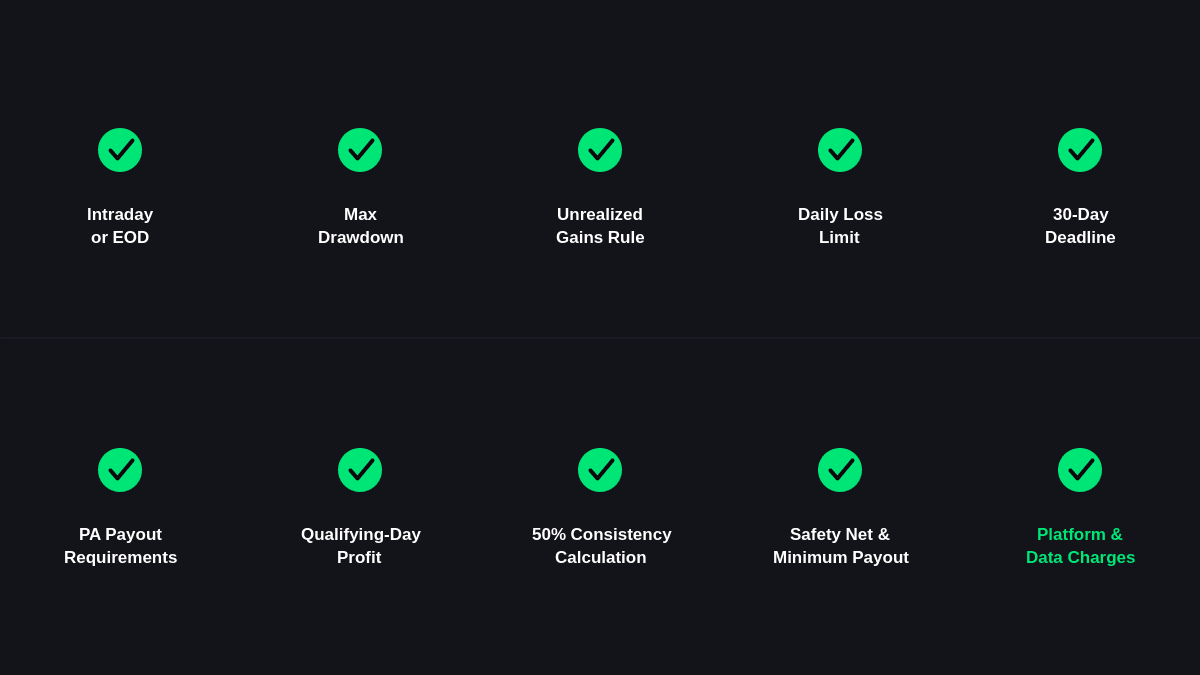
A meaningful comparison should start with the current account type rather than an older review or simulation.
Check:
- Whether the evaluation is Intraday or EOD.
- The applicable maximum drawdown.
- Whether unrealized gains move the threshold.
- Whether a Daily Loss Limit applies.
- The 30-calendar-day evaluation deadline.
- Current Performance Account payout requirements.
- The applicable qualifying-day profit amount.
- The 50% consistency calculation.
- The Safety Net and minimum payout conditions.
- Any current platform or data-related charges.
A trader can then compare those requirements against the statistics produced by a tested strategy.
Final Thoughts
Apex Trader Funding is easier to understand when you look at its current account rules separately from its older simulations.The 2026 structure uses one-time evaluation purchases with a 30-calendar-day access period, while traders can choose between Intraday and EOD evaluation models. Intraday evaluations use a real-time trailing threshold, whereas EOD evaluations calculate drawdown at market close and add a Daily Loss Limit.
In the case of a funded system, there are additional requirements such as the five trading day rule, a Safety Net, minimum payout requirements, and 50 percent consistency requirement. The above requirements indicate that achieving the evaluation profit goal is just one aspect of the task.
Although the results from Monte Carlo simulation may show how certain restrictions affect the performance of simulations, their assumptions must not be taken as today’s statistics for Apex. Traders are supposed to test their systems on the actual account design using drawdown and daily profit information among others before comparing them.