Choosing the right brokerage account can affect how you buy securities, manage available funds, and handle investment risk.
The Cash Account vs Margin Account decision largely comes down to whether you want to trade only with money you have deposited or have access to borrowing from your broker. Each account structure has different rules, costs, and considerations.
A cash account is generally straightforward because purchases are funded with available cash, while a margin account allows an investor to borrow against eligible securities or account assets.
Understanding these differences can help investors evaluate which setup fits their trading activity, risk tolerance, and approach to managing capital, including how much capital to allocate to individual positions with a Position Sizing Calculator.
What Is a Cash Account and Margin Account?
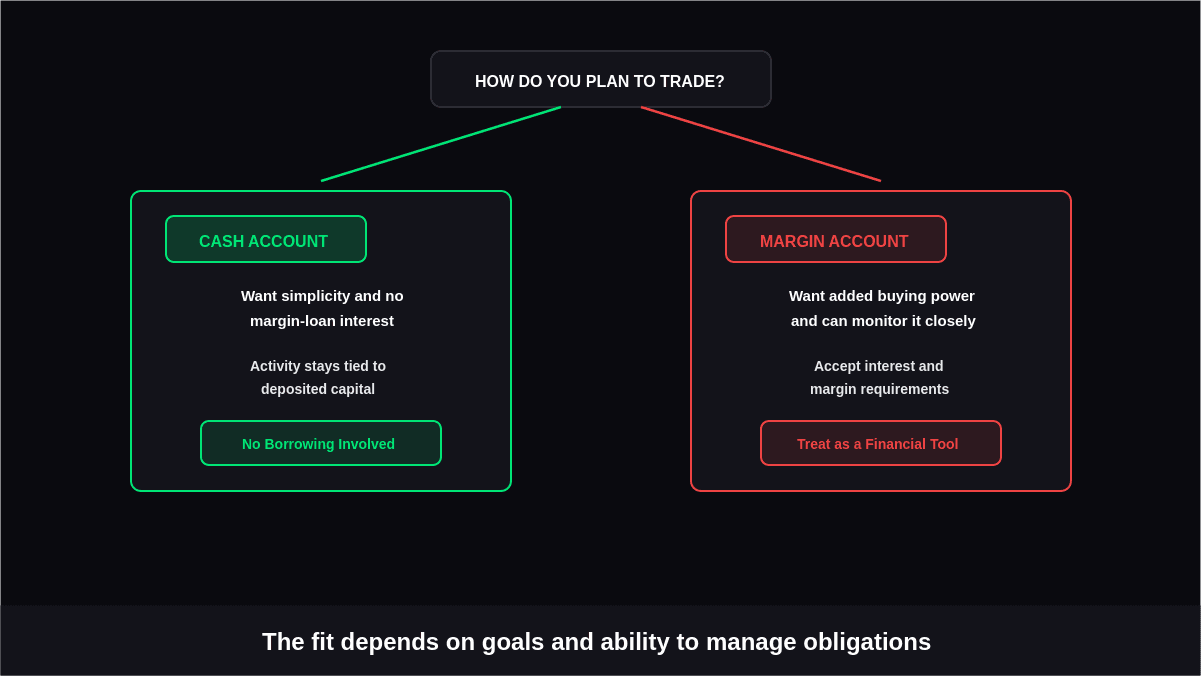
The fundamental distinction is how transactions are funded. A cash account uses the investor’s available funds, while a margin account can provide borrowing capacity subject to the broker’s rules and applicable requirements.
Cash Account
A cash brokerage account requires you to pay for securities using available cash rather than borrowing from your broker. This structure can make portfolio funding easier to track because your purchases are tied directly to the money deposited into the account.
Key characteristics include:
- Securities are purchased using available cash.
- There is no margin loan for ordinary purchases.
- You generally do not pay margin interest because you are not borrowing for trades.
- Buying power is based on eligible available funds.
- Selling investments does not automatically create additional borrowed capital.
- Trading is subject to applicable settlement and brokerage rules.
A cash account can be useful for investors who want to keep their investment activity within the amount of capital they have available.
Margin Account
A margin trading account allows an investor to borrow money from a brokerage against eligible assets, subject to applicable rules and the broker's requirements. This can increase purchasing power, but it also introduces borrowing costs and additional risks.
Key characteristics include:
- The broker may provide borrowing capacity against eligible securities.
- Available buying power can exceed the cash deposited in the account.
- Borrowed funds generally incur interest.
- The account is subject to maintenance and other margin requirements.
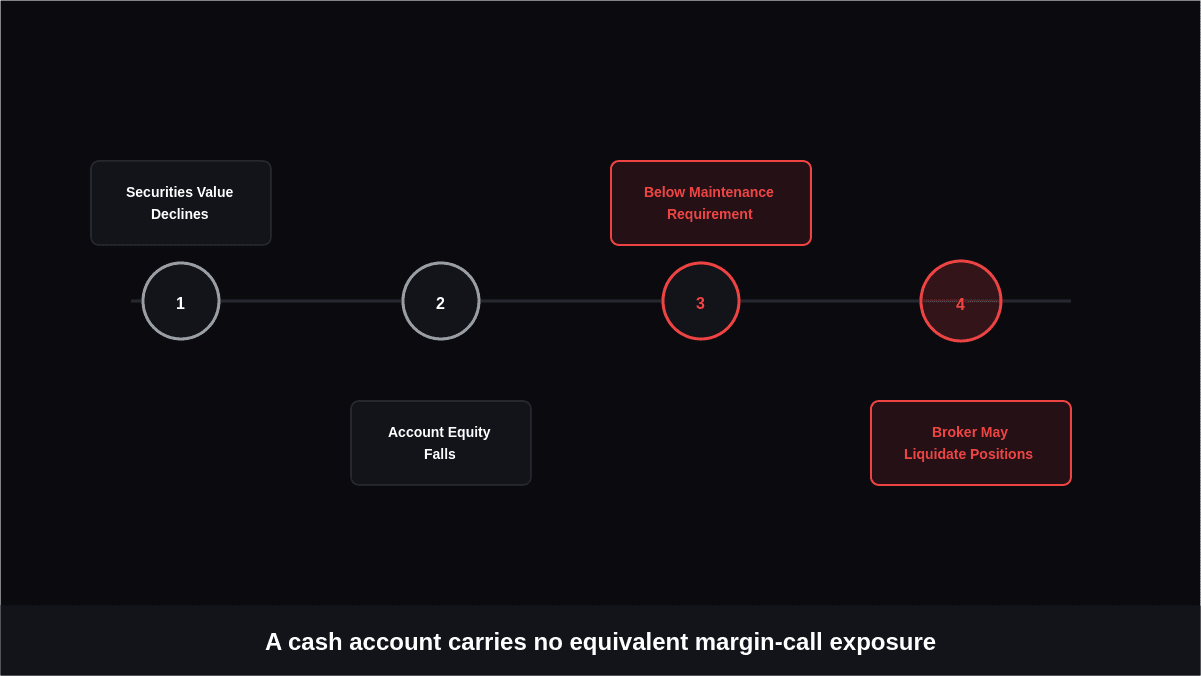
- Market losses can affect both the investment value and available borrowing capacity.
- A broker may have the ability to liquidate securities when requirements are not met.
Margin therefore adds another layer to portfolio management because investors must consider both their positions and their outstanding borrowing.
Cash Account vs Margin Account
The two account types can look similar when used for ordinary stock purchases, but their underlying mechanics are different. The table below highlights the areas that can have the greatest practical effect on an investor.
| Feature | Cash Account | Margin Account |
|---|---|---|
| Funding | Uses available cash | Uses cash plus permitted borrowing |
| Borrowing | No borrowing for standard purchases | Borrowing may be available against eligible assets |
| Interest | No margin-loan interest | Interest may apply to borrowed funds |
| Buying power | Generally limited to available funds and applicable rules | Can be higher because borrowing may increase purchasing capacity |
| Account requirements | Primarily governed by cash and settlement rules | Subject to broker and regulatory margin requirements |
| Loss exposure | Generally limited to the amount invested in a position | Generally limited to the amount invested in a position |
| Forced liquidation risk | No margin call from borrowing | Positions may be liquidated if margin requirements are not maintained |
| Trading flexibility | More limited in certain strategies | May support additional strategies, depending on eligibility and broker rules |
| Complexity | Relatively straightforward | Requires monitoring of borrowing, interest, and margin levels |
The right structure depends on how an investor intends to use the account rather than simply which account offers more purchasing power. Greater flexibility can also introduce additional obligations.
5 Key Differences Between Cash Account & Margin Account
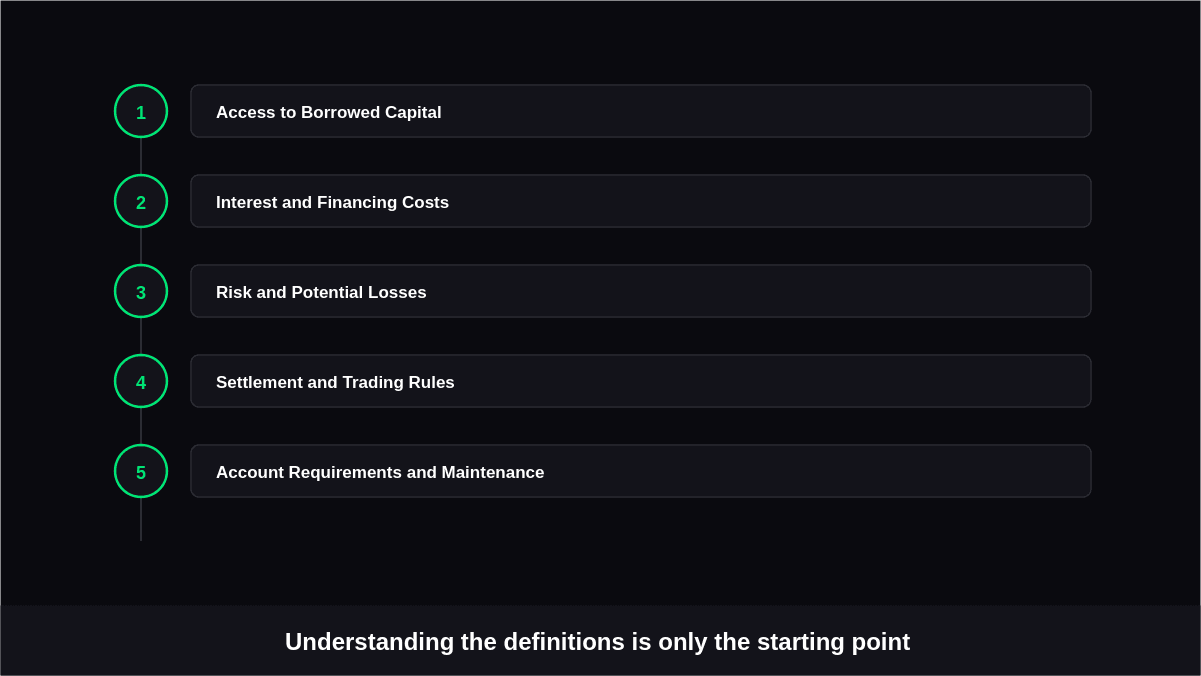
Understanding the basic definitions is only the starting point. The following five differences explain how the two structures can affect actual investment decisions and account management.
1. Access to Borrowed Capital
The most important distinction is whether the investor can borrow from the brokerage.
With a cash account, purchases are funded through available capital. A margin account may allow borrowing against eligible securities, which can increase the amount an investor can deploy.
- Cash accounts do not provide ordinary margin borrowing.
- Margin accounts can provide additional purchasing capacity.
- Borrowing creates an obligation that must be repaid.
- The amount available to borrow can change as the value of securities changes.
The additional capital available through margin is not the same as additional investment capital. It represents credit that comes with financial obligations.
2. Interest and Financing Costs
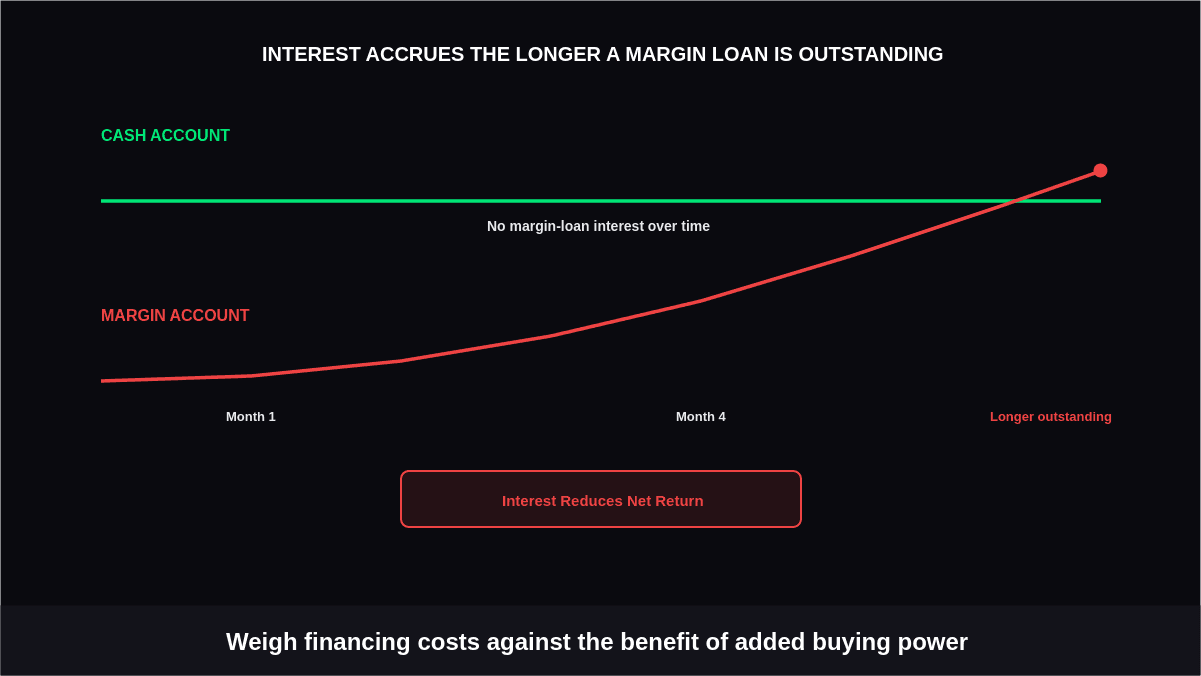
Borrowing can introduce costs that do not normally exist when an investor uses only available cash.
A margin account may charge interest on outstanding margin loans. The applicable rate and calculation method depend on the brokerage and account terms.
- Cash purchases generally do not create margin-loan interest.
- Margin borrowing can generate ongoing financing costs.
- Interest reduces the net return from an investment.
- The cost becomes particularly relevant when borrowed funds remain outstanding for longer periods.
Investors considering margin should therefore evaluate the financing expense alongside the potential benefit of additional buying power.
3. Risk and Potential Losses
Both account types expose investors to market losses, but margin adds borrowing to the equation.
In a cash account, an investor can lose money when a purchased security declines. In a margin account, losses can reduce account equity while the borrowed amount remains an obligation.
- Investment values can decline in either account.
- Margin borrowing can increase the financial impact of a decline.
- A significant drop in asset values can reduce available margin.
- Investors may need to provide additional funds or reduce positions if requirements are not met.
This makes risk monitoring especially important when borrowed capital is involved.
4. Settlement and Trading Rules
Cash and margin accounts can also differ in how investors manage proceeds from transactions and comply with trading rules.
Cash-account investors need to pay attention to whether funds are available for a new purchase and whether transaction proceeds have settled under applicable rules.
- Cash must be available for purchases.
- Transaction settlement can affect when funds can be reused.
- Brokerage platforms may display settled and unsettled funds separately.
- Margin accounts can provide different treatment because borrowing may be available, subject to applicable rules.
Investors should check their broker's current policies rather than assuming that every account follows identical trading procedures.
5. Account Requirements and Maintenance
A margin account carries additional conditions because the brokerage is extending credit.
These margin account requirements can include minimum equity levels, maintenance requirements, and other conditions established by the broker and applicable regulations.
- Minimum account equity may apply.
- Maintenance requirements can change the amount that can be borrowed.
- Declining securities values can affect compliance.
- Brokers may have the right to sell securities under specified circumstances.
Cash accounts generally avoid these borrowing-related maintenance requirements, making their structure simpler for investors who do not need leverage.
Investor Insights on Cash Account vs Margin Account
Account selection is not simply a question of choosing between limited and expanded buying power. Investors should consider how each structure fits their objectives, experience, liquidity, and ability to manage additional obligations.
Consider How You Plan to Use Your Capital
Investors who primarily purchase securities with funds they already have may find the cash structure easier to monitor. It keeps investment activity closely connected to deposited capital and avoids margin-loan interest.
Those who require additional purchasing flexibility may consider a margin structure, but the ability to borrow should be treated as a financial tool rather than automatically as an advantage.
Before choosing, consider:
- How much capital you intend to invest.
- Whether you need borrowing capacity.
- How frequently you trade.
- Whether you can monitor account requirements regularly.
- Whether potential financing costs fit your strategy.
- How comfortable you are with additional financial obligations.
Understand the Trade-Off Between Flexibility and Complexity
Margin can expand the range of transactions and strategies available to an eligible investor, but it also requires closer attention to account equity, borrowing costs, and broker requirements.
A cash account can offer a more direct relationship between deposited funds and investment purchases. However, it may not provide the same flexibility for investors who specifically need margin-enabled strategies.
The important step is to understand the mechanics before opening or changing an account. Brokerage firms can also impose requirements beyond general regulatory standards, so investors should review the account agreement and current terms before using margin.
Conclusion
The Cash Account vs Margin Account comparison ultimately centers on how investments are funded and what obligations come with the chosen structure. Cash accounts use available funds, while margin accounts can introduce borrowing, interest expenses, maintenance requirements, and additional risk.
Neither structure should be viewed in isolation from an investor’s goals and circumstances. Reviewing available capital, trading needs, financing costs, account rules, and risk exposure can provide a clearer basis for deciding which type of brokerage account is appropriate for your situation.
Regularly evaluating these factors is also part of how to review your trades and understanding how your account structure affects your trading decisions.