Every new trader goes through the same phase. You find an indicator on TradingView, backtest it for a weekend, convince yourself this is the one, and then watch it fail in live market conditions. So you go back to the library, find another one, pay for a premium tool this time, and repeat the cycle. The indicator was never the problem. Your process was.
This guide is not going to tell you that paid indicators are a scam or that free ones are all you need. Both of those takes are lazy. What actually matters is knowing when each type of tool fits your situation, and more importantly, understanding what drives profitability in the first place. Here we are going to break down the real differences between free Vs paid TradingView indicators, when each one actually makes sense, and what you need to fix before either one works for you.Free indicators are enough to build a working strategy. Paid indicators can make execution faster and cleaner for active traders. Neither one makes you profitable on its own. That part is on you.
What Are TradingView Indicators?
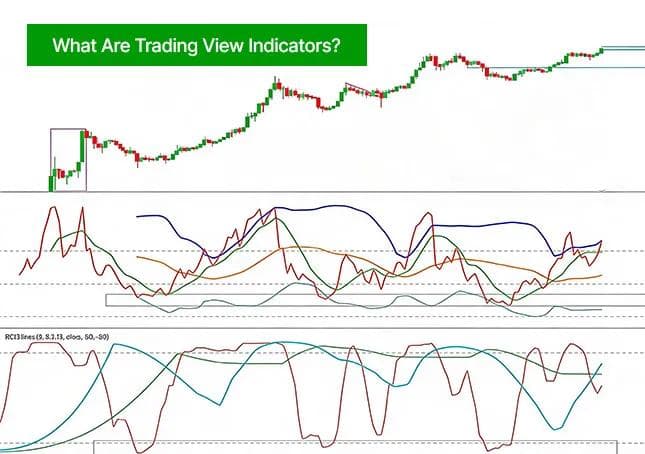
Indicators take raw price and volume data and turn it into something visual on your chart. A line, a histogram, a colored candle, anything that helps you read what the market is doing without staring at raw numbers.
They track four things primarily:
- Trend looks at whether price is moving up, down, or going nowhere.
- Momentum tells you how fast that move is happening and whether it is losing steam.
- Volume shows whether real money is behind a move or if it is just noise.
- Volatility measures how wild price is swinging at any given time.
On TradingView specifically, you get three types:
Built-in indicators are already on your chart the moment you open TradingView. RSI, MACD, Bollinger Bands, moving averages. These have been used by traders for decades. They are free and they work.
Community scripts are indicators other traders built and shared publicly. The quality range here is massive. Some are genuinely useful tools built by experienced developers. Others are half-finished scripts that have not been touched in three years. Always check the publish date, the comments section, and whether the developer is still active before you trust one of these.
Paid indicators are tools you pay for, either monthly or as a one-time purchase. They come from independent developers or trading companies. Better logic, cleaner design, and actual support if something breaks.
Free vs Paid TradingView Indicators: Where They Actually Differ
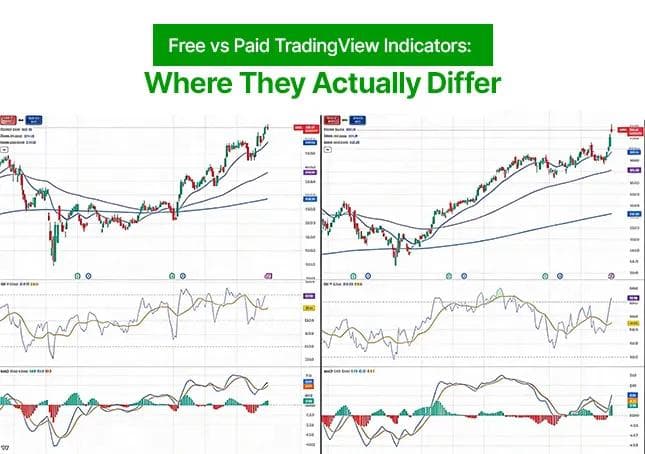
Signal Quality
Free indicators run standard formulas. The RSI you use is the same RSI every other trader on the platform uses. When millions of people watch the same level on the same indicator, the edge gets thin fast. Signals work, but they are basic.
Paid indicators layer extra logic on top. Multi-timeframe filters, volatility adjustments, trend confirmation built into the signal itself. You get fewer signals but they tend to carry more weight. Still, a bad paid indicator with fancy marketing is worse than a simple free one you actually understand.
Customization
With free tools, you adjust the period and maybe the color. That is the ceiling. Paid tools let you dial in sensitivity, add filters, set conditions for alerts, and sometimes connect to automation tools that place trades for you. If your strategy needs specific behavior from an indicator, free tools often cannot deliver that.
Reliability Over Time
TradingView updates Pine Script regularly. Free community indicators break when this happens because nobody is maintaining them. You come back one morning and your whole setup is throwing errors. Paid developers fix these things fast because their subscribers complain immediately. Their income depends on the tool working. That accountability makes a real difference.
Support
Free indicator breaks, you leave a comment and hope. Sometimes you get a response in a week. Sometimes never. Paid indicator breaks, you open a support ticket or post in a Discord and someone actually helps you. For active traders where every session matters, that difference is not small.
The Cost Question
Free costs nothing but gives you limited depth and a crowded signal. Paid costs real money, anywhere from $20 to $200 a month depending on the tool. That cost only makes sense if the tool genuinely improves how you trade. A lot of paid indicators will not. The trading indicator market is full of products with great sales pages and mediocre performance. Do your research before handing over money.
Do Paid Indicators Make You More Profitable?
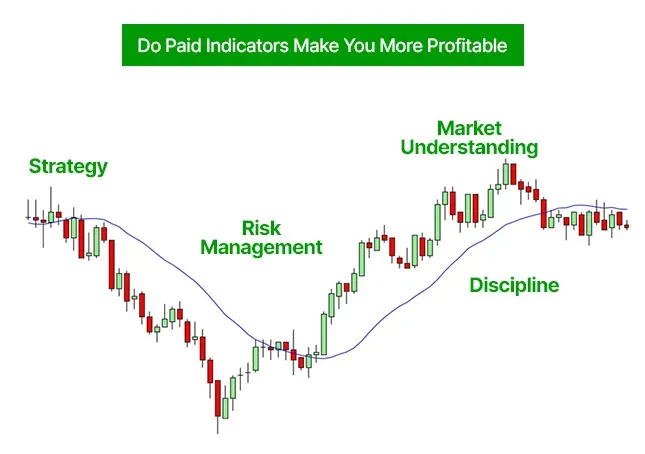
No. And neither do free ones. Profitability comes from four things that have nothing to do with which indicator you pick:
- Strategy. You need rules for when you enter, when you exit, and why. Without that, an indicator just gives you random reasons to click buttons.
- Risk management. Most traders who blow accounts do it through poor position sizing, not bad signals. One bad trade should never threaten your account. If it does, the indicator is not the issue.
- Market understanding. You need to know what price is doing at a structural level before any indicator reading makes sense. Indicators confirm what price is already telling you. They do not replace reading the market.
- Discipline. This is the one nobody wants to talk about. You can have a perfect setup and still lose money consistently because you move stop losses, skip entries when you feel nervous, or revenge trade after a loss. No indicator in the world fixes that.
A paid tool in the hands of a disciplined trader with a real strategy can speed things up and cut noise. That same tool in the hands of someone without those foundations just loses money faster.
When Free Indicators Are the Right Call
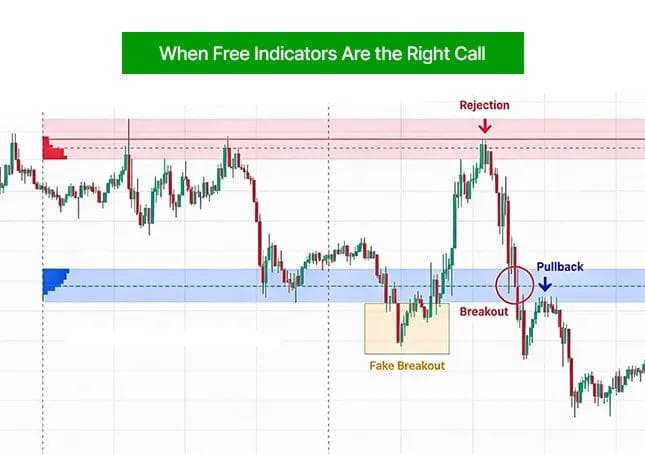
Free tools are often more than enough, especially when you focus on learning and keeping your setup simple.
You are learning. Free tools are everything you need when you are starting out. Paying for premium indicators before you understand how markets move is skipping the foundation and wondering why the house falls down.
Your strategy is straightforward. Trend trading, support and resistance setups, basic breakouts. None of these require expensive tools. The classics handle them fine.
You are testing a new idea. Always test with free tools first. If the concept holds up over time, then consider whether a paid tool would sharpen the execution.
The four free indicators worth actually learning:
- RSI shows momentum and helps spot when price is overextended in either direction.
- MACD tracks trend direction and flags when momentum is shifting.
- Moving averages show you the trend at a glance and act as areas where price tends to react.
- Volume tells you whether the move you are watching has real participation or not.
Plenty of traders run profitable accounts with just these four. Do not underestimate them because they are free.
When Paying for an Indicator Makes Sense
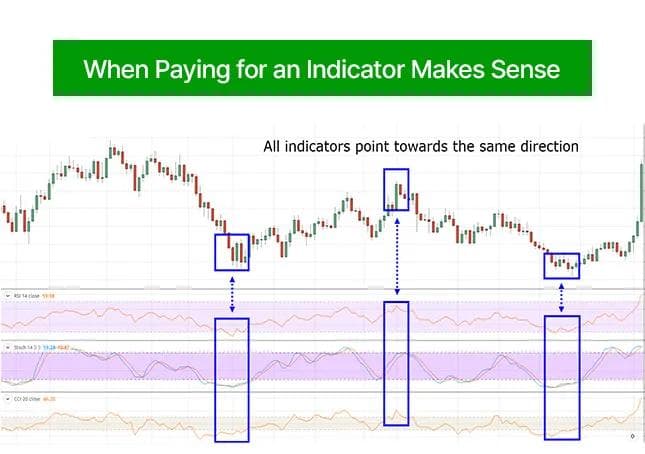
Now, if you are wondering if paid indicators are worth it, the answer is very simple. Paying for a tool can be worth it when it clearly improves how you trade, not just how your chart looks.
- You are day trading or scalping. Speed matters in short timeframes. A cleaner signal that fires a few seconds earlier can be the difference between a good entry and chasing price. If you trade the 1 or 5 minute chart regularly, signal quality matters more than it does for swing traders.
- You need real automation. Free alerts are basic. If your strategy depends on conditional alerts or direct integration with a bot that executes trades, free tools cap out fast.
- You want confluence without the clutter. Some paid tools pull together trend, momentum, and volume into one clean output. Instead of running five separate indicators and manually checking if they all agree, you get one reading. For traders who are time-pressed or who trade multiple instruments, this actually saves meaningful time.
Types of paid indicators worth looking at:
- Smart money concepts tools track where institutional money is likely positioned by mapping liquidity zones and market structure.
- Order block indicators mark supply and demand areas where large players previously entered. These often act as strong support and resistance.
- Multi-indicator dashboards combine several signals into one panel. Useful for scanning multiple pairs quickly without opening a cluttered chart for each one.
Pros and Cons
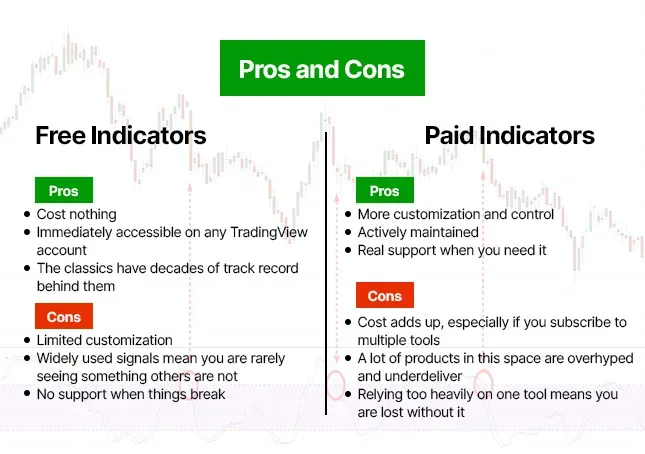
Free Indicators
Pros:
- Cost nothing
- Immediately accessible on any TradingView account
- The classics have decades of track record behind them
Cons:
- Limited customization
- Widely used signals mean you are rarely seeing something others are not
- No support when things break
Paid Indicators
Pros:
- More customization and control
- Actively maintained
- Real support when you need it
Cons:
- Cost adds up, especially if you subscribe to multiple tools
- A lot of products in this space are overhyped and underdeliver
- Relying too heavily on one tool means you are lost without it
TradingView indicators comparison
| Feature | Free Indicators | Paid Indicators |
|---|---|---|
| Cost | Free | Monthly pr one-time |
| Signal depth | Standard | Additional filtering |
| Customization | Basic | High |
| Alerts | Simple | Conditional and complex |
| Support | None | Included |
| Maintenance | inconsistent | Regular |
| Best for | Learning, simple strategies | Active trading, automation |
Case Study: Same Setup, Two Different Tools
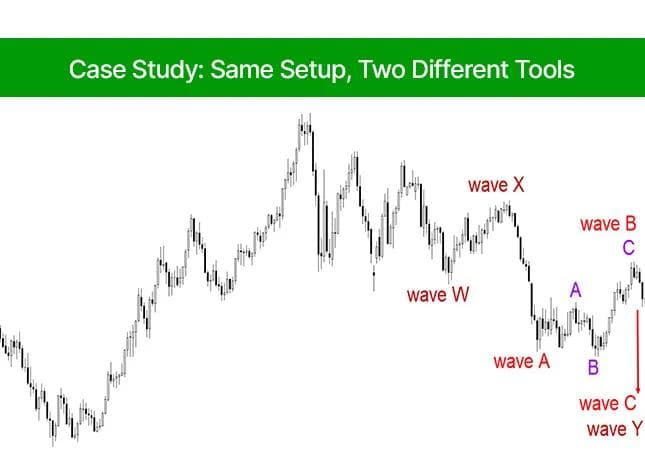
EUR/USD, 15-minute chart, uptrend in play.
With free tools:
You have RSI and a 20 EMA on the chart. Price pulls back to the EMA. RSI dips to 45 then curls up. You enter long on the close of that candle. Entry is slightly late because you waited for confirmation. Stop goes below the EMA. You had a basic RSI alert set but it fired after you already saw the setup anyway. Decision time: about 90 seconds.
With a paid SMC tool:
The indicator has already marked an order block just below where price is pulling back. Price drops into that zone. The tool flags a long signal with a confluence score that factors in trend, session timing, and volume. The alert fires before the candle closes. You enter earlier, stop sits tighter below the order block. Decision time: under 30 seconds.
Both setups could have made money on that trade. The difference is entry precision and speed. Across many trades, those small differences in entry quality do add up. But run either setup without a stop loss strategy and position sizing rules, and both blow up eventually.
How to Pick What Is Right for You
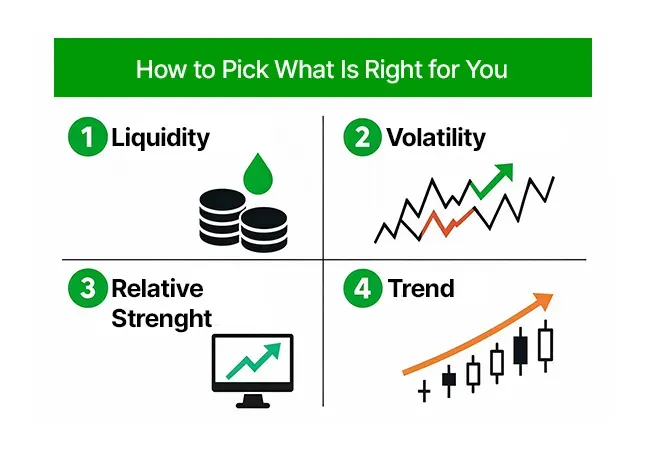
The right tool depends on your experience level. What works for one trader can confuse another, so keep it simple and match tools to your current skill.
If you are a beginner: Use free built-in indicators only. Learn why a signal fires before you trust it. Adding paid tools at this stage just adds confusion.
If you are intermediate: You likely have a strategy that mostly works. Try adding one paid tool that targets a specific weakness in your execution, whether that is entry timing, alert reliability, or confluence confirmation.
If you are advanced: You already know your edge. The question is whether a paid tool makes executing that edge faster or cleaner. If yes, it is worth the cost. If not, skip it.
Before buying any indicator, run through this:
- Does it actually fit my strategy or am I just excited about it?
- Can I explain how the signal works in plain terms?
- Have other traders outside the sales page reviewed this tool?
- Will the monthly cost affect how I feel about my trading?
Using Both Together
The most practical approach for most traders is using both types.
- Free indicators handle the big picture. Moving averages tell you the trend. Volume tells you if moves are real. Basic RSI tells you if price is stretched. These answers do not require a paid tool.
- Paid indicators handle the entry trigger. Once you know the structure from your free tools, a premium indicator can tell you the specific moment to act with more precision.
Keep the chart clean regardless. Three to four indicators is a reasonable ceiling for most traders. A chart with twelve indicators does not produce better decisions. It produces slower ones.
Mistakes That Actually Cost Traders Money
Most traders don’t lose because of bad luck. They lose because of simple mistakes they repeat again and again without fixing them.
- Looking for the perfect indicator: It does not exist. Every indicator is a lagging representation of what price already did. The goal is a tool you trust and understand, not one that never fails.
- Buying tools you cannot explain: If you need the developer to tell you whether to buy or sell, you do not have a strategy. You have a dependency. That breaks the moment the market does something the tool did not account for.
- Adding more indicators to fix a losing strategy: More inputs on a broken strategy just give you more reasons to make bad trades. Fix the strategy first.
- Treating risk management as optional: Say it plainly: most traders who consistently lose money have a risk management problem, not an indicator problem. Position sizing and stop loss discipline matter more than any tool you can buy.
Final Words
Free indicators are not inferior tools for people who cannot afford better. They are the foundation of how most professional traders learned to read markets, and they remain useful at every level. Paid indicators are not shortcuts to profitability. They are execution tools for traders who already know what they are doing and want to do it faster or more precisely. Get your strategy working with free tools. Learn to manage risk before you manage your indicator library. When your process is solid and you identify a specific gap that a paid tool fills, then it makes sense to pay for one. That order matters. Most traders get it backwards.Tools like GainzAlgo V2 can then help refine execution and improve clarity once your trading process is properly developed. Learn How to Use GainzAlgo on YouTube
FAQs
Are paid TradingView indicators worth it?
Depends entirely on where you are in your trading. If you have a working strategy and clear rules, a paid tool can improve how you execute it. If you are still losing consistently, a paid tool adds cost without fixing the real problem.
Can you be profitable with only free indicators?
Yes. Many traders run profitable strategies using RSI, MACD, moving averages, and volume and nothing else. The free tools are not the bottleneck.
What is the best TradingView indicator?
There is no correct answer to this. The best indicator is the one that fits your specific strategy and timeframe. Trend traders lean on moving averages. Momentum traders use RSI and MACD. Traders focused on institutional price action use order blocks and SMC tools. Match the tool to the approach, not the other way around.
Do indicators guarantee profits?
Nothing in trading does. Indicators help you read conditions and time entries. They do not account for news spikes, liquidity grabs, or the hundred other things that make markets unpredictable. They are one input in your decision, not the whole decision.