When comparing GainzAlgo vs Traditional Trading Indicators, the main difference is not simply that one is newer than the other. The more useful comparison is how each approach fits into the trading workflow.
Traditional indicators such as moving averages, RSI, and MACD generally give traders individual measurements or conditions that must be interpreted within a strategy.
GainzAlgo is designed around direct BUY and SELL signals, with different versions adding features such as alerts, presets, and, in V2, built-in take-profit and stop-loss levels.
That distinction affects how traders analyze charts, define entries, manage positions, and test a strategy.
GainzAlgo vs Traditional Trading Indicators at a Glance
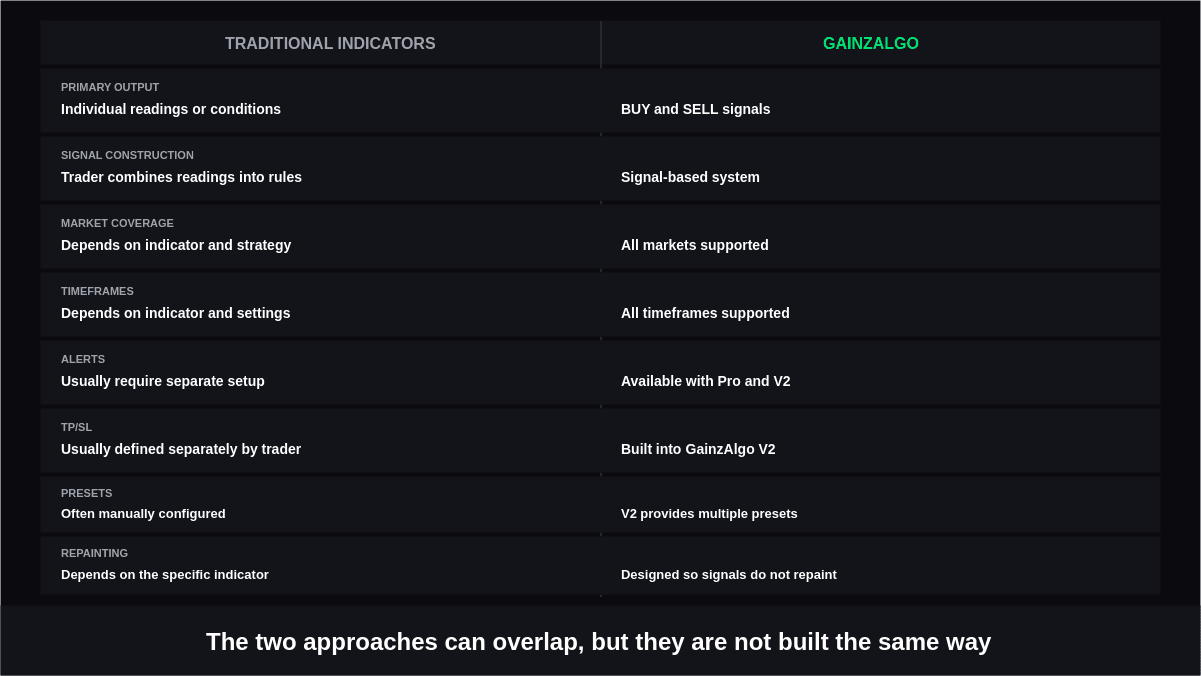
The two approaches can overlap, but they are not structured in exactly the same way.
| Feature | Traditional Trading Indicators | GainzAlgo |
|---|---|---|
| Primary output | Individual indicator readings or conditions | BUY and SELL signals |
| Signal construction | Trader usually combines readings into rules | Signal-based system |
| Market coverage | Depends on the indicator and strategy | All markets supported |
| Timeframes | Depends on the indicator and settings | All timeframes supported |
| Alerts | Usually require separate platform configuration | Available with GainzAlgo Pro and V2 |
| TP/SL | Usually defined separately by the trader | Built into GainzAlgo V2 |
| Presets | Often manually configured | V2 provides multiple presets |
| Repainting | Depends on the specific indicator | GainzAlgo is designed in way that its signals do not repaint |
How the Two Approaches Generate Trading Signals
Traditional indicators generally start with a mathematical calculation applied to price or other market data. A moving average, for example, calculates an average price over a selected period. RSI measures momentum using its own formula, while MACD compares moving averages.
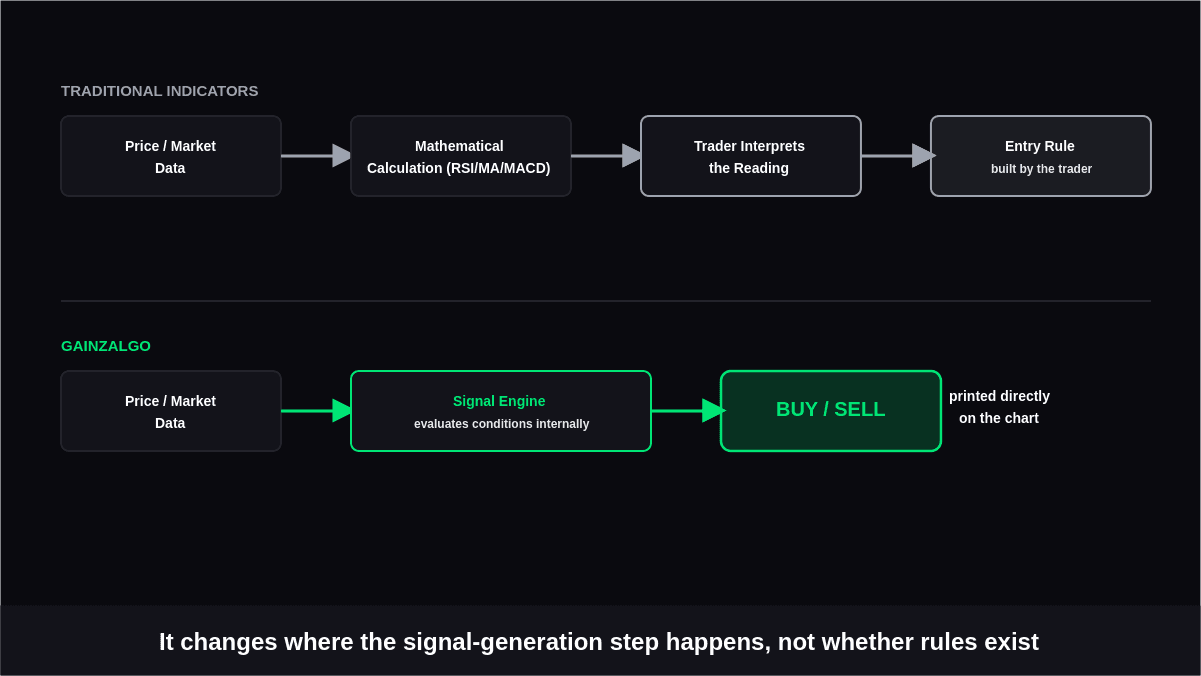
The trader then decides what those readings mean within a strategy.
For example, a strategy might define a moving-average crossover as an entry condition and use another indicator as confirmation. The indicator itself provides the measurement; the trading rules determine how that measurement becomes a trade.
GainzAlgo approaches the process differently. Its standard product is designed to print BUY and SELL signals directly on a selected TradingView chart.
This means the output is already presented in a signal-oriented format rather than requiring the trader to construct an entry condition from several separate indicator readings.
This does not eliminate the need for strategy rules or risk management. It changes where the signal-generation step occurs in the workflow.
How GainzAlgo Changes the Trading Workflow
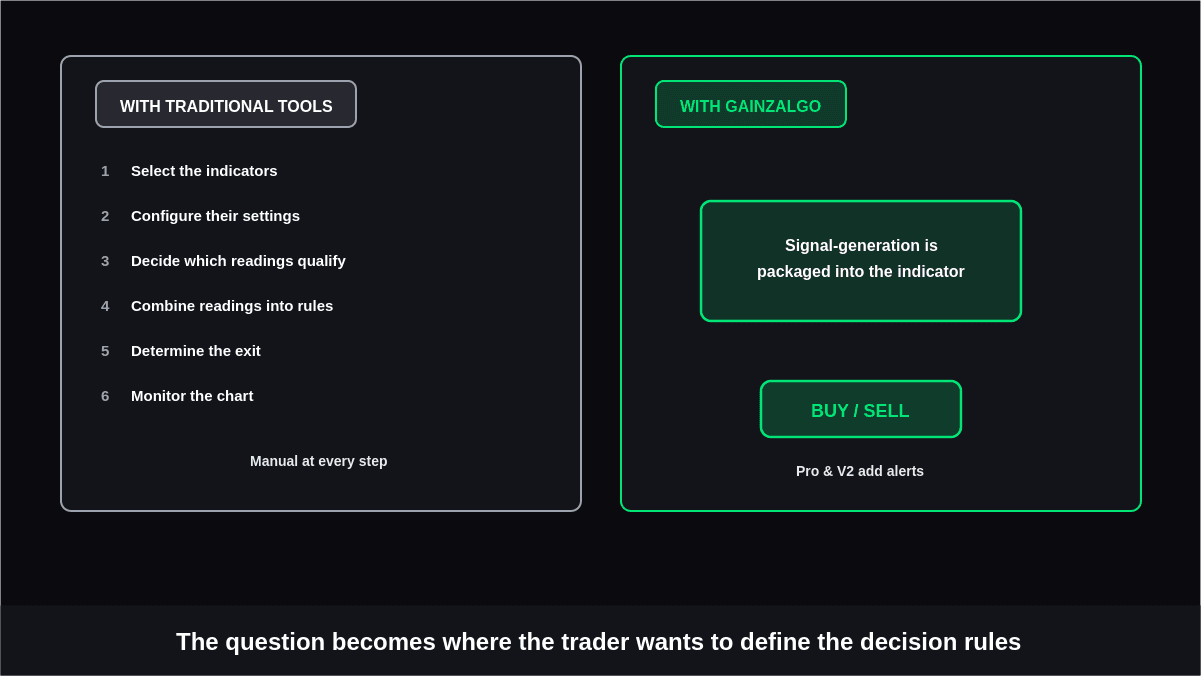
The practical difference becomes clearer when looking at what happens after the chart is open.
With traditional indicators, a trader may need to:
- Select the indicators.
- Configure their settings.
- Decide which readings qualify as a setup.
- Combine those readings into entry rules.
- Determine when an exit should occur.
- Monitor the chart for qualifying conditions.
GainzAlgo packages more of the signal-generation process into the indicator itself. The standard version provides BUY and SELL signals, while Pro and V2 can be used with TradingView alerts. GainzAlgo's alert documentation shows that users can create BUY or SELL alerts from the indicator.
This makes the comparison less about whether indicators are useful and more about where the trader wants to define the decision rules.
Market and Timeframe Flexibility
Another difference is how the tools are positioned across markets and timeframes.
A traditional indicator such as RSI or a moving average can technically be applied to many markets, but the way it is used depends on the trader's settings and strategy.
A setup designed for a daily stock chart may require different rules when applied to a short-term crypto chart.
GainzAlgo’s system works across markets and timeframes, including stocks, crypto, forex, commodities, and indices. Its V2 product also lists all-market and all-timeframe coverage, with presets designed for different trading conditions.
The V2 Alpha page specifically describes multi-timeframe functionality and customizable presets.
The important distinction is therefore not that traditional indicators cannot be used across markets. They can. The difference is that GainzAlgo works as a more complete signal-oriented system rather than as an individual calculation that the trader must build into a broader process.
Risk Management Is a Separate Part of the Comparison
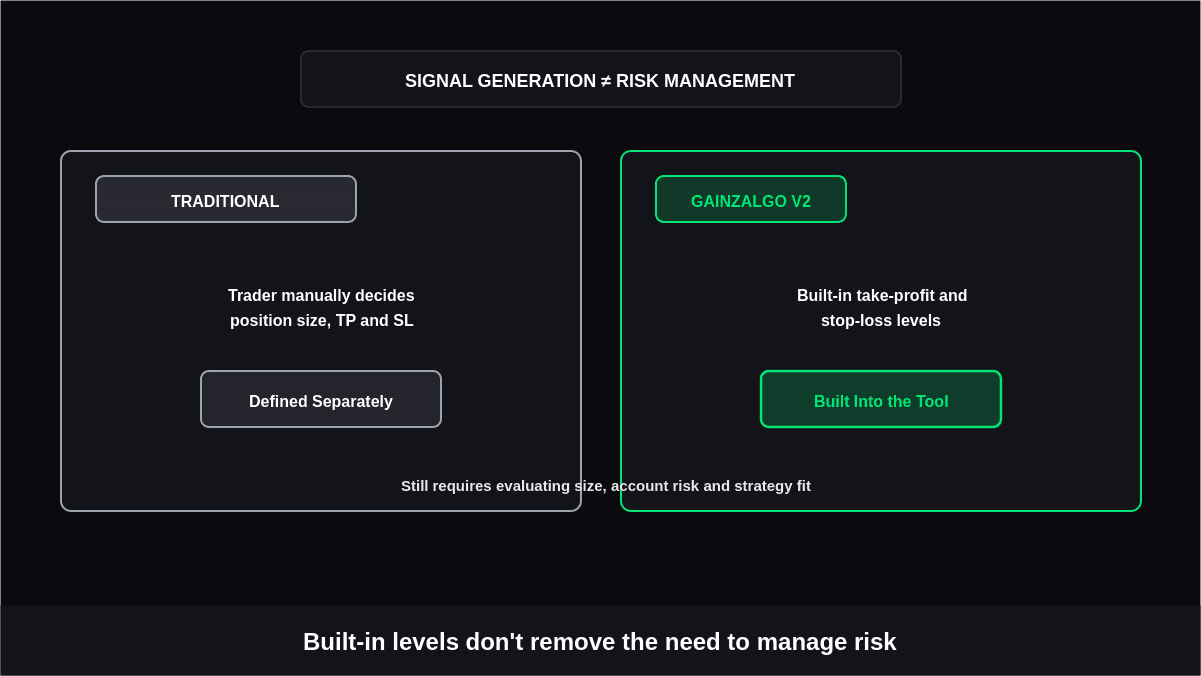
Signal generation and risk management should not be treated as the same thing.
A traditional indicator generally tells the trader something about price, momentum, trend, or another market characteristic. The trader normally decides how much to risk and where an exit should be placed.
GainzAlgo V2 adds built-in take-profit and stop-loss levels as part of its documented feature set.
That can change the workflow because the trader does not necessarily need to create a separate indicator-based process for determining those levels.
However, having suggested or built-in levels does not remove the need to evaluate position size, account risk, market conditions, and whether the levels fit the trader's strategy.
Repainting Is a Different Issue From Signal Generation
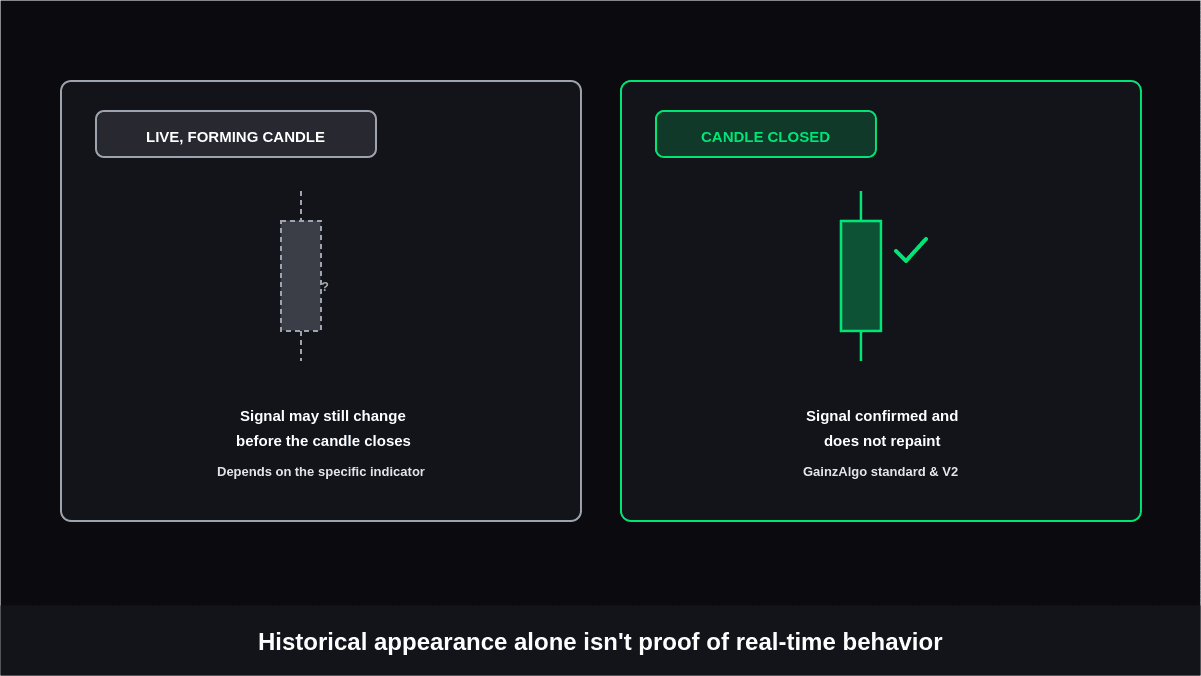
Repainting should be evaluated separately from the question of whether an indicator provides buy or sell signals.
An indicator can generate signals but still requires testing to determine whether historical signals remain stable after the relevant candle closes. This is why checking signal behavior on historical charts is important when comparing different trading indicator signals.
GainzAlgo standard product does not repaint, and GainzAlgo V2 also lists no repainting among its features.
For any indicator, traders should still understand exactly when a signal becomes confirmed and how it behaves on the live, forming candle. Historical chart appearance alone should not be treated as sufficient evidence of real-time behavior.
Where Traditional Indicators Still Fit
1: Comparing GainzAlgo with traditional indicators does not mean traditional indicators become irrelevant.
2: Individual indicators can still serve specific analytical purposes. A trader may use a moving average to examine trend direction, RSI to examine momentum conditions, or another indicator as an additional confirmation tool.
3: The difference is that these tools generally provide individual pieces of information. The trader decides how those pieces fit into the overall strategy.
4: This can also make traditional indicators useful for traders who want to build and customize their own rules rather than rely primarily on a predefined signal system.
5: GainzAlgo can also be incorporated into a broader analysis process rather than being treated as the only source of information. The important point is to understand what each tool contributes before adding it to a strategy.
How to Compare GainzAlgo With Traditional Indicators Properly
A meaningful comparison should focus on the same conditions rather than simply counting visible signals.
For example, a trader testing the two approaches could keep the following factors consistent:
- Same market
- Same timeframe
- Same testing period
- Same starting capital
- Same transaction-cost assumptions
- Clearly defined entry rules
- Clearly defined exit rules
- Consistent position sizing
- Out-of-sample testing where appropriate
The purpose is to determine how the trading strategy behaves rather than assuming that more signals automatically mean better results.
It is also useful to record more than the number of winning trades. Metrics such as drawdown, average trade, risk-adjusted performance, trade frequency, and consistency across different market conditions can provide a more complete picture.
Conclusion
The key difference in GainzAlgo vs Traditional Trading Indicators is the structure of the trading workflow.
Traditional indicators generally provide individual measurements that traders incorporate into their own rules. This gives traders considerable control over how they construct a strategy, but it also means more of the signal-generation process is handled manually.
GainzAlgo is structured around direct trading signals. Its standard product provides BUY and SELL signals across markets and timeframes, while V2 adds features such as presets and built-in TP/SL levels.
Neither description by itself establishes how profitable a strategy will be. Results depend on the market, timeframe, rules, execution, risk management, and testing process.
The useful question is therefore not simply which tool is better. It is which workflow matches the way a trader wants to analyze markets and construct a strategy.