Pre-Market vs Regular Market trading involves two different periods in which traders can potentially buy and sell securities. Although both allow market participants to respond to price movements, they operate under different conditions.
Lower participation, wider spreads, and fewer available orders can make early trading behave differently from the main session.
Understanding these differences can help traders interpret price movements more accurately and choose an approach that matches their strategy. Rather than treating every price change the same way, traders can consider multi timeframe context, how much participation is behind it, and whether sufficient liquidity is available.
In this blog, we will explore how pre-market and regular trading sessions work, what makes them different, and the factors traders should consider before placing orders during either period.
What Are Pre-Market and Regular Market Sessions?
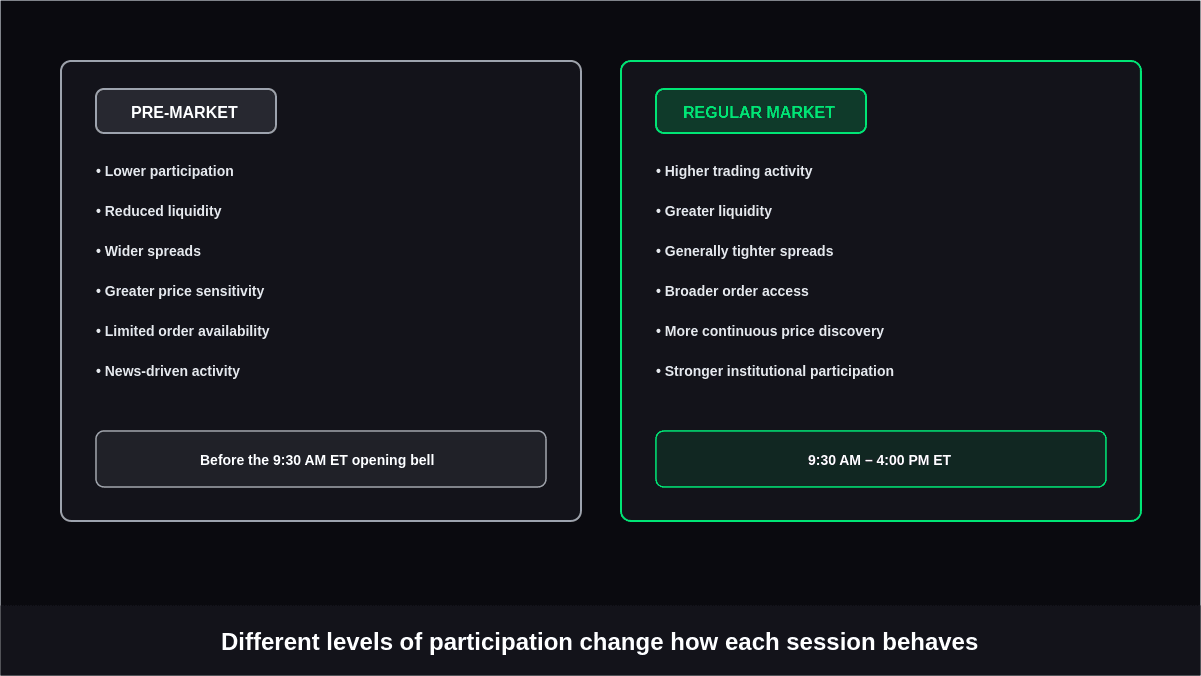
The trading day is divided into periods with different levels of participation and market activity. The pre-market session occurs before the primary exchange session opens, while the regular session represents the main trading period.
Pre-Market
Pre-market trading takes place before the regular session begins. In U.S. equities, the commonly referenced pre-market period runs before the 9:30 a.m. Eastern Time opening bell, although exact availability can vary by broker and venue.
Activity during this period can increase when companies release earnings, economic data, regulatory announcements, or other news outside regular hours.
Key characteristics include:
- Lower participation: Fewer traders and institutions may be active compared with the main session.
- Reduced liquidity: There may be fewer shares available at individual price levels.
- Wider spreads: The difference between available bid and ask prices can become larger.
- Greater price sensitivity: New information can cause substantial movements when fewer orders are available.
- Limited order availability: Certain order types or trading features may not be supported by every broker.
- News-driven activity: Earnings releases and overnight developments can have a stronger immediate effect.
Because conditions can change quickly, a price move during this period does not necessarily provide the same information as an equivalent move during the main session.
Regular Market
Regular market hours represent the primary trading session for an exchange. For U.S. stocks listed on major exchanges, the standard session generally runs from 9:30 a.m. to 4:00 p.m. Eastern Time.
This period typically attracts substantially more market participation and provides a deeper pool of buyers and sellers.
Important characteristics include:
- Higher trading activity: More market participants are generally present.
- Greater liquidity: More orders can be available across different price levels.
- Generally tighter spreads: Increased participation can improve bid-ask conditions.
- Broader order access: Traders typically have access to a wider range of standard order functionality.
- More continuous price discovery: A larger number of transactions can help establish market prices.
- Stronger institutional participation: Large market participants are generally more active during the main session.
These characteristics do not eliminate volatility. Major economic releases, earnings announcements, unexpected headlines, and market-wide events can still produce rapid price changes.
Pre-Market vs Regular Market: Key Differences
The biggest distinction is not simply the time on the clock. The market environment can change significantly between sessions.
For example, a stock may rise sharply before the opening bell after an earnings announcement. Once the regular session begins, thousands or millions of additional shares may trade, potentially changing the balance between buyers and sellers.
The table below highlights the practical differences traders should understand:
| Factor | Pre-Market Trading | Regular Market Trading |
|---|---|---|
| Trading period | Before the primary session | Main exchange session |
| Typical participation | Lower | Higher |
| Liquidity | Often lower | Generally higher |
| Bid-ask spread | Can be wider | Often tighter |
| Price volatility | Can be elevated | Varies with market conditions |
| Price discovery | More limited | More extensive |
| Order execution | Can be less predictable | Generally more consistent |
| Market depth | Often thinner | Usually deeper |
| Impact of individual orders | Potentially greater | Often smaller in highly liquid stocks |
| News reaction | Can be immediate and sharp | News is incorporated through heavier trading |
| Broker availability | Varies by broker | Widely available |
| Best suited to | Traders monitoring early developments | Broad range of trading strategies |
These differences explain why a chart can look very different before and after the opening bell. Traders should evaluate the trading environment alongside the price itself instead of assuming that every session provides identical conditions.
Why Can Pre-Market Prices Behave Differently?
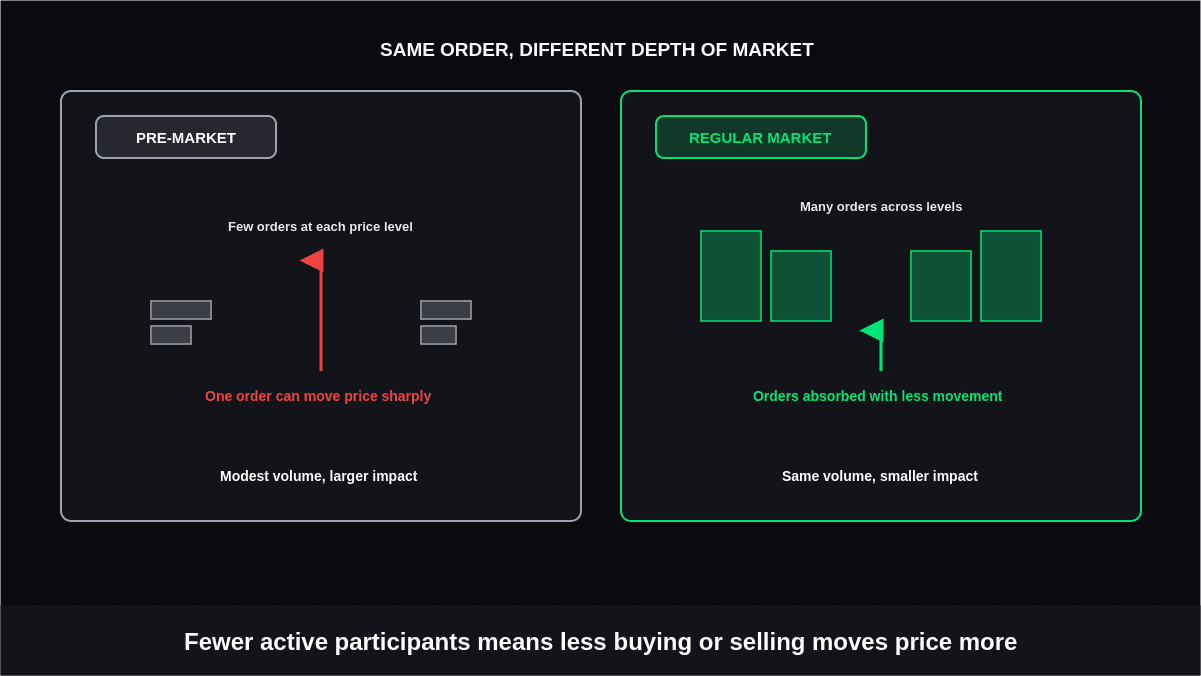
One reason is the smaller number of active participants. When fewer orders are available, relatively modest buying or selling pressure can move a security more noticeably.
Overnight developments can also create a significant gap between the previous closing price and the current pre-market price.
Examples include earnings results, analyst revisions, company announcements, geopolitical developments, and economic data.
However, an early price can change considerably once regular trading begins. The opening session brings additional participants, fresh orders, and potentially different interpretations of the same information.
This is why traders often distinguish between an overnight indication and the price established after broader participation enters the market.
Why Can Regular-Market Prices Behave Differently?
Regular-market prices can behave differently because the main session brings a much larger number of buyers, sellers, institutions, and active orders into the market. This increased participation can change the balance of supply and demand compared with the quieter pre-market period.
Price movements may also respond differently once regular trading begins because overnight news is reassessed with greater liquidity and broader participation.
A stock that moves sharply before the opening bell may continue in the same direction, reverse, or settle into a narrower range as more market participants enter and new orders are executed.
What Traders Should Consider Before Extended-Hours Trading
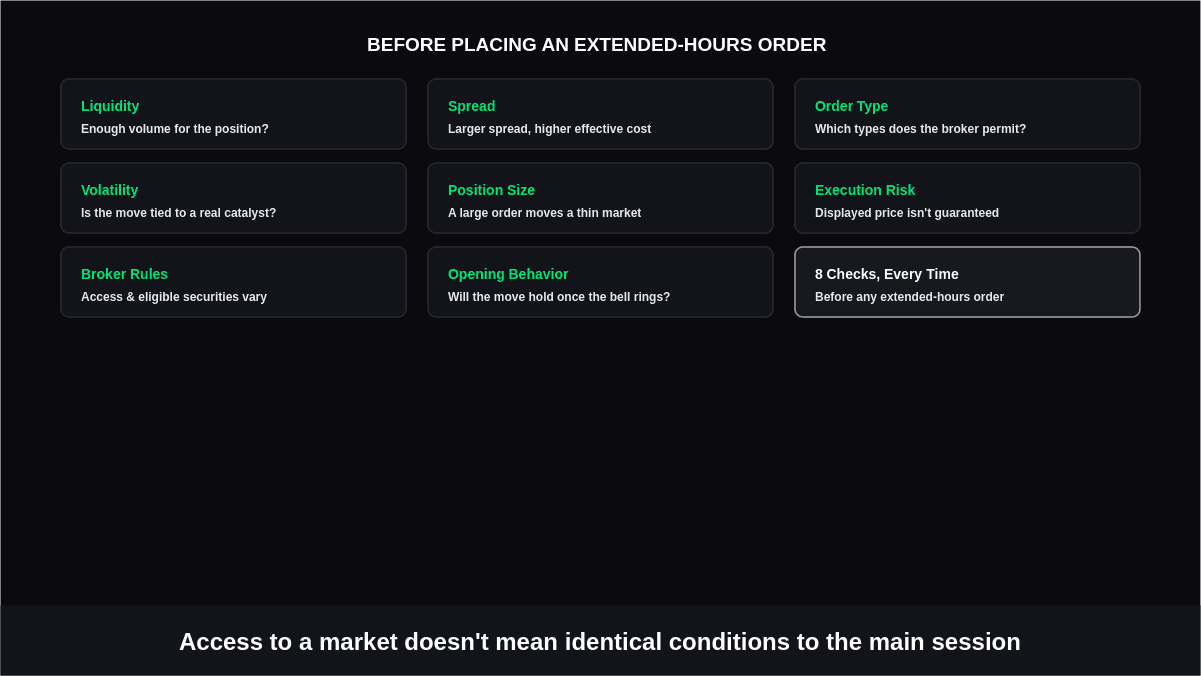
Extended-hours trading can provide flexibility, but access to a market does not mean that conditions are identical to the main session.
Before placing an order, traders should consider:
- Liquidity: Check whether sufficient volume is available for the intended position.
- Spread: A larger bid-ask spread can increase the effective cost of entering or exiting.
- Order type: Understand which order types the broker permits during the session.
- Volatility: Determine whether the price movement is connected to a specific catalyst.
- Position size: A large order can have a greater impact in a thin market.
- Execution risk: The displayed price may not guarantee the actual execution price.
- Broker rules: Extended-session access, eligible securities, and trading windows vary between providers.
- Opening behavior: Consider whether the pre-market move remains relevant once the main session starts.
These checks can help separate a meaningful market development from a temporary movement caused by limited participation.
How News Can Affect Both Trading Sessions
News is one of the clearest reasons traders pay attention to activity outside regular hours. Companies may release quarterly results before the opening bell or after the regular session closes.
Suppose a company reports earnings that significantly exceed market expectations before the opening. Its shares may move sharply during the pre-market session. Once regular trading begins, the larger participant base can either reinforce that move or push the price in another direction.
The important point is that the timing of a move provides context. Traders should examine the underlying catalyst, volume, liquidity, and subsequent price action instead of relying solely on the percentage change displayed on a chart.
Which Session Should Traders Use?
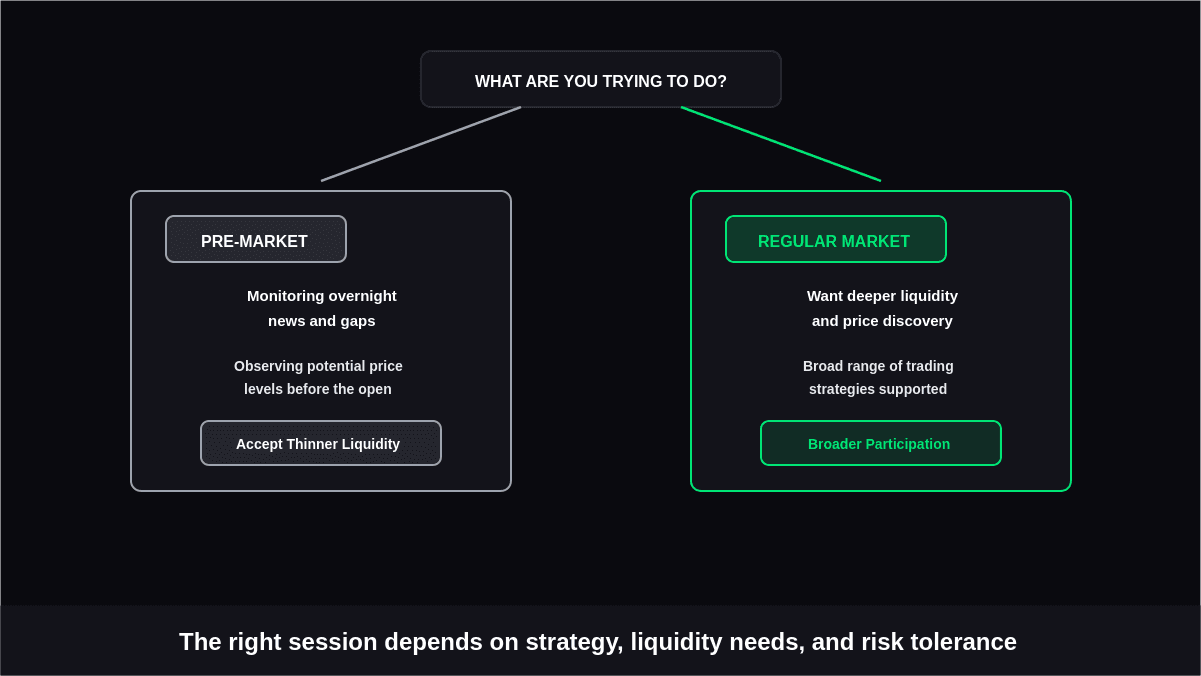
There is no single session that fits every trading approach. The appropriate choice depends on the strategy, available liquidity, risk tolerance, instruments being traded, and broker access.
A trader monitoring overnight news may use the pre-market period to observe potential gaps and important price levels. Another trader may prefer the main session because higher participation can provide more liquidity and more active price discovery.
Rather than choosing a session simply because it appears more active or produces larger price movements, traders can assess whether the conditions support their specific setup.
Conclusion
Understanding Pre-Market vs Regular Market conditions gives traders better context for interpreting price behavior. Pre-market activity can provide early information about overnight developments, but lower liquidity and wider spreads may make Market Orders vs Limit Orders execution and price interpretation more challenging.
Regular market hours generally bring broader participation and deeper trading activity, while still carrying risks related to volatility and unexpected events.
By considering liquidity, spreads, volume, catalysts, order execution, and the reason behind a price move, traders can evaluate each session based on its actual market conditions rather than treating them as interchangeable.