Picking the wrong currency pair is rarely why traders lose money. The real damage happens at the moment of execution. A late entry, an early exit, a stop that was too tight because nothing on the chart gave a clear enough reason to hold. That is the precision problem in forex, and it costs traders far more than bad pair selection ever will. A smart trading indicator for forex is the closest thing to a solution. It takes raw, noisy price data and turns it into structured, readable signals so your decisions are based on logic rather than instinct.
From what smart trading indicators for forex actually are, to how the most reliable ones work, which ones are worth your attention, and how to build a setup that helps you trade with more confidence and less guessing, it is all covered here.
What Is a Smart Trading Indicator in Forex?
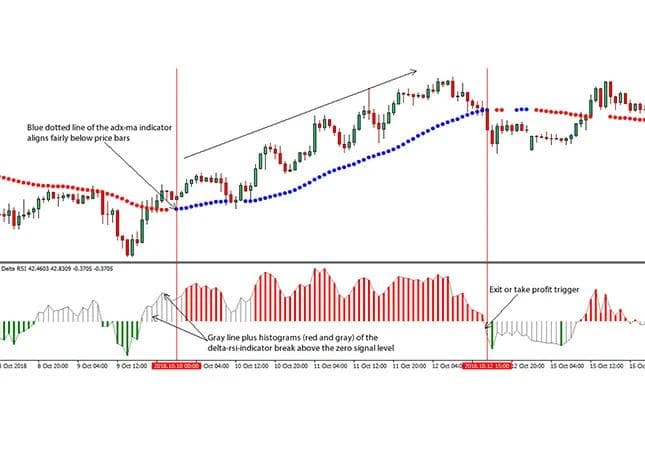
A trading indicator is a tool built on price data that helps you read what the market is doing. It takes raw price movement, which can feel random, and turns it into signals you can actually act on. A smart trading indicator goes a step further. Instead of just tracking one data point like closing price or volume, it processes multiple inputs such as momentum, trend direction, volatility, and support or resistance zones, then combines them into cleaner, more reliable signals.
The word "smart" is used loosely in trading. But in practical terms, it means an indicator that:
- Filters out noise instead of reacting to every small price move
- Works across different market conditions, both trending and ranging
- Gives you a signal before the obvious move, not after most of it is done
- Does not repaint its signals once a candle closes
If an indicator ticks most of these boxes, it qualifies as a smart one.
Why Precision Matters More Than You Think
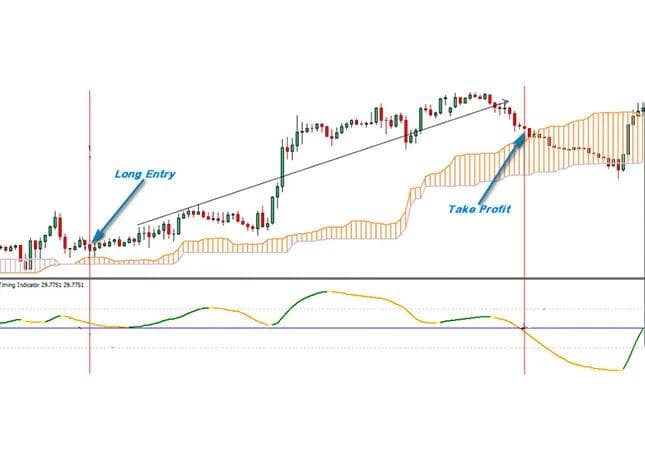
Here is something most beginners discover the hard way: being right about direction is not enough. You can call a bullish trend correctly and still lose the trade because your entry was 30 pips too late. Your stop loss gets hit on a wick before the price moves in your direction. You entered at resistance without realising it. Or you sized the position based on a signal that looked clean on a demo account but repainted on live.
Precision in forex comes down to three things:
- Entry timing: Getting in close enough to a valid level so your stop loss is tight and your risk to reward works in your favour.
- Signal clarity: Knowing whether a signal is strong or weak before you commit.
- Exit discipline: Having a reason to stay in or get out based on the chart, not emotion.
A good indicator helps with all three. A bad one gives you false confidence and a lighter account.
How Smart Trading Indicators for Forex Actually Work
Smart Money Concepts (SMC)
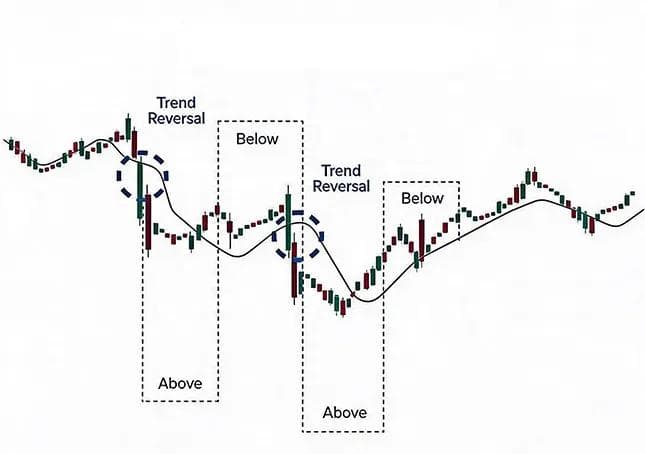
One of the more popular frameworks in 2026 is Smart Money Concepts. The idea is that large institutional players such as banks, hedge funds, and liquidity providers leave footprints in price. They need massive volume to fill their orders, which creates identifiable zones on the chart. Smart trading indicators for forex built on SMC try to map out where those institutional orders sit. They look for things like order blocks, which are areas where a strong move began, fair value gaps, which are imbalances in price delivery, and liquidity sweeps, where price takes out retail stop losses before reversing. The practical benefit is simple. Instead of entering on a moving average crossover and hoping for the best, you are entering at levels where there is a structural reason for price to react.
Multi-Timeframe Analysis
One major difference between a basic indicator and a smarter one is how it handles timeframes. A basic RSI on the 15-minute chart tells you what momentum looks like on that single timeframe. A smarter indicator checks alignment. Does the daily trend agree with the 4-hour structure? Is the 1-hour showing a pullback into a demand zone that the 15-minute is now confirming? This layered analysis reduces false signals. You stop fighting the larger trend and start trading with it.
Signal Filtering
Not every setup is worth taking. Most indicators treat all signals equally. Smart ones apply filters. A filter might check whether volume confirms the breakout, whether the signal appears at a key level instead of mid-range, or whether momentum is expanding or contracting at the point of entry. The result is fewer signals, but ones that have a higher probability of working out.
The Most Useful Trading Indicators for Forex Precision
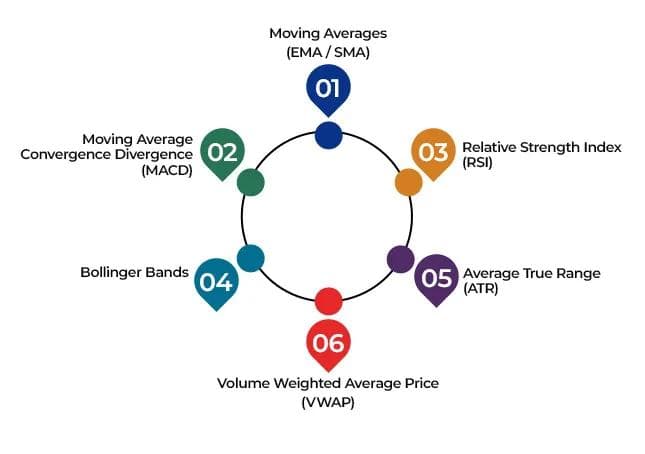
You do not need to run 12 indicators on one chart. That is a quick way to get confused and trade nothing. Here are the indicators that have consistently proven useful for forex traders, and why each one earns its place.
Moving Averages (EMA / SMA)
Moving averages are the starting point for trend trading. The Exponential Moving Average reacts faster to recent price, which is useful for short-term traders. The Simple Moving Average weights all periods equally, which is more useful for identifying longer-term trend direction.
The 50 EMA and 200 EMA are the most watched. When price is above both and they are stacked in the right order, the trend is up. It is a simple rule but a powerful filter. Where traders go wrong is using moving averages in a ranging market. They are trend tools, not oscillators. Use them for direction, not entries.
MACD
MACD stands for Moving Average Convergence Divergence, but what matters is what it tells you. It measures the distance between two moving averages. When that gap is growing, momentum is building. When it shrinks, momentum is fading. The histogram shows the pace of change, which is often more useful than the signal line alone.
In forex, MACD divergence is one of the more reliable signals. When price makes a new low but the histogram makes a higher low, momentum is shifting before price confirms it. That gives you an early read on a potential reversal.
RSI (Relative Strength Index)
RSI measures how fast and how far price has moved over a set period. Readings above 70 suggest the market may be overbought, while readings below 30 suggest oversold. On longer timeframes, these levels are genuinely useful. On shorter ones, overbought can stay overbought for a long time during strong trends.
The best use of RSI in 2026 is in combination with a trend filter. If price is in a downtrend and RSI bounces from 30 back up to the 50 to 60 range without crossing higher, that often signals continuation and a possible short entry.
Bollinger Bands
Bollinger Bands draw a dynamic channel around price based on volatility. When the bands tighten into a squeeze, volatility is low and a move is likely building. When they widen, that move is already underway.
For forex traders, the squeeze is the most useful signal. A sustained period of narrow bands often comes before a sharp directional move. Pairing Bollinger Bands with a momentum indicator like RSI gives you both the setup and the trigger.
ATR (Average True Range)
ATR does not tell you direction. It tells you how much a pair is moving on average. This makes it one of the most underrated tools on the list, especially for stop loss placement. If you set a 10-pip stop on a pair with an ATR of 80 pips, you will get stopped out by normal market movement. ATR-based stops adapt to the market instead of forcing fixed numbers onto it. A common method is to multiply ATR by 1.5 or 2 and use that as your stop distance.
VWAP (Volume Weighted Average Price)
VWAP is the average price of a pair weighted by volume. It shows where the market has traded the most, which makes it a magnet for price during the session.
For intraday forex traders, VWAP acts as a dynamic level. Price above VWAP with volume suggests buyers are in control. Price returning to VWAP from above can be a potential long setup if the broader trend supports it.
How to Build a Precision Setup Without Overcomplicating It
Here is a practical framework for combining indicators without cluttering your chart.
- Start with trend. Use the 50 or 200 EMA to define direction on a higher timeframe. Only take trades that align with this direction.
- Add context. Use Bollinger Bands or ATR to understand volatility. Is this a high-momentum environment or a slow grind?
- Look for entry signals. MACD divergence, RSI at a key level, or a candlestick pattern at a zone of interest. Pick one confirmation tool you understand well.
- Size your stop based on ATR, not a fixed pip number. ATR-based stops respect the natural range of the pair.
That is four elements. None of them conflicts. Each serves a specific job. Traders who struggle usually stack multiple oscillators on the same chart and wait for all of them to agree. That level of agreement rarely happens, and when it does, the move is often already over.
Common Mistakes That Kill Precision
- Using indicators in the wrong market condition. Trend indicators like moving averages give poor signals in a ranging market. Oscillators like RSI give poor signals in a strong trend. Know your environment before choosing your tools.
- Treating all signals as equal. A MACD crossover at the 200 EMA on the daily chart is not the same as one at a random midpoint on the 15-minute chart. Location matters.
- Ignoring the higher timeframe. You can have a perfect setup on the 15-minute chart that goes directly against the daily trend. It will fail more often than not.
- Changing settings constantly. Indicators have default settings for a reason. Tweaking them to fit past data means you are optimising for history, not the future.
- Expecting an indicator to replace a trading plan. An indicator helps inform decisions. It does not make them for you. If you do not know what you are looking for before opening the chart, no indicator will fix that.
What Makes Gainzalgo's Indicator Different
Most indicators are built on a single method and applied to everything. That is why results can be inconsistent. Forex pairs behave differently, and market conditions shift constantly. Gainzalgo's smart trading indicator for forex was built specifically for forex precision. It combines real-time signal generation with multi-timeframe alignment, so you are not trading against the broader structure. It filters signals based on market conditions, which means it does not overwhelm you with setups. It is also non-repainting. What you see on a closed candle stays there. That matters more than most traders realise, since many indicators look clean in hindsight because their signals shift after the candle closes. If you are trading forex and are tired of entries that look good on paper but fail in execution, it is worth testing.
Final Thoughts
A smart trading indicator for forex does not make trading easy. It makes it clearer. The difference between consistent traders and struggling ones usually comes down to discipline and decision quality, not the number of tools on the chart. Indicators are there to support decisions, not replace them. What you want from any indicator is honesty. Clear signals, no repainting, and consistent behaviour across different market conditions. That is what precision in forex really means. Not perfect trades, but consistent and well-reasoned ones. If you want more clarity, start with fewer tools and understand each one before adding another. Give each indicator one job. If a setup does not meet your criteria, skip it.
The best trade you never took is one that would have been a loss. Gainzalgo helps forex traders cut through noise with algorithmic precision. Explore the indicator and see how it performs on your pairs.
FAQs
What is the most accurate trading indicator for forex?
No single indicator is the most accurate. Accuracy depends on how it is used and the market conditions. Indicators like MACD, RSI, and EMA systems perform well when used with proper filters and context.
What is a smart money indicator in forex?
A smart money indicator tracks the behaviour of large institutional players such as banks and funds. It identifies order blocks, liquidity zones, and structural shifts that signal institutional activity.
Can I use just one indicator for forex precision?
Yes, but you need strong awareness of market context. Most traders benefit from combining one trend tool with one momentum or volatility tool.
Are smart trading indicators good for beginners?
Yes, as long as they are simple. Beginners should focus on clear, non-repainting indicators instead of complex systems.
What is the best indicator for forex entry and exit?
For entries, a mix of a trend filter like EMA and a momentum signal like MACD or RSI works well. For exits, ATR-based trailing stops or structural levels are commonly used.