A short position is created when a trader sells a security they do not own, typically after arranging to borrow the shares needed for delivery. The borrowed shares allow the trader to sell first and potentially buy them back later at a lower price.
The process involves more than simply selling a stock, because the borrowed security remains part of the transaction until the short is closed.
When shares are borrowed for a short sale, the broker or another securities lender temporarily provides the stock, usually in exchange for lending-related fees or other costs.
The trader remains responsible for eventually returning equivalent shares and meeting applicable margin requirements. These factors should also be considered when using a Position Sizing Calculator to determine the appropriate size of a short position.
In this blog, we will explore how borrowing works in a short sale, how a short position differs from a long position, and what can happen from the moment shares are borrowed until the trade is closed.
What Is a Short Position in Trading?
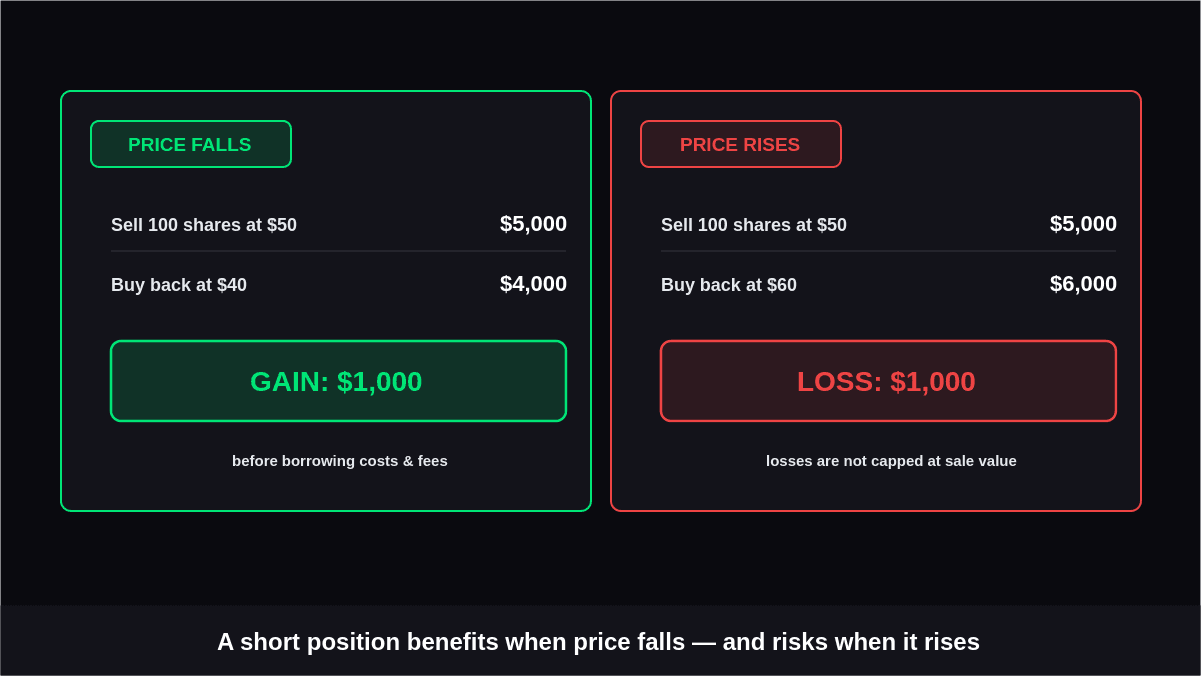
A short position represents an exposure to a security where the trader generally benefits if its market price declines. Instead of purchasing shares and holding them, the trader sells borrowed shares and later seeks to purchase equivalent shares to return to the lender.
For example, suppose a trader borrows 100 shares priced at $50 each and sells them for $5,000. If the price later falls to $40, buying 100 replacement shares costs $4,000. Before borrowing costs, fees, and other expenses, the difference is $1,000.
The opposite can also happen. If the shares rise to $60, replacing the borrowed shares would cost $6,000, creating a $1,000 loss before additional costs. Because a stock's price can theoretically continue rising, losses on a short position are not capped at the original sale value.
Short Position vs Long Position in Trading
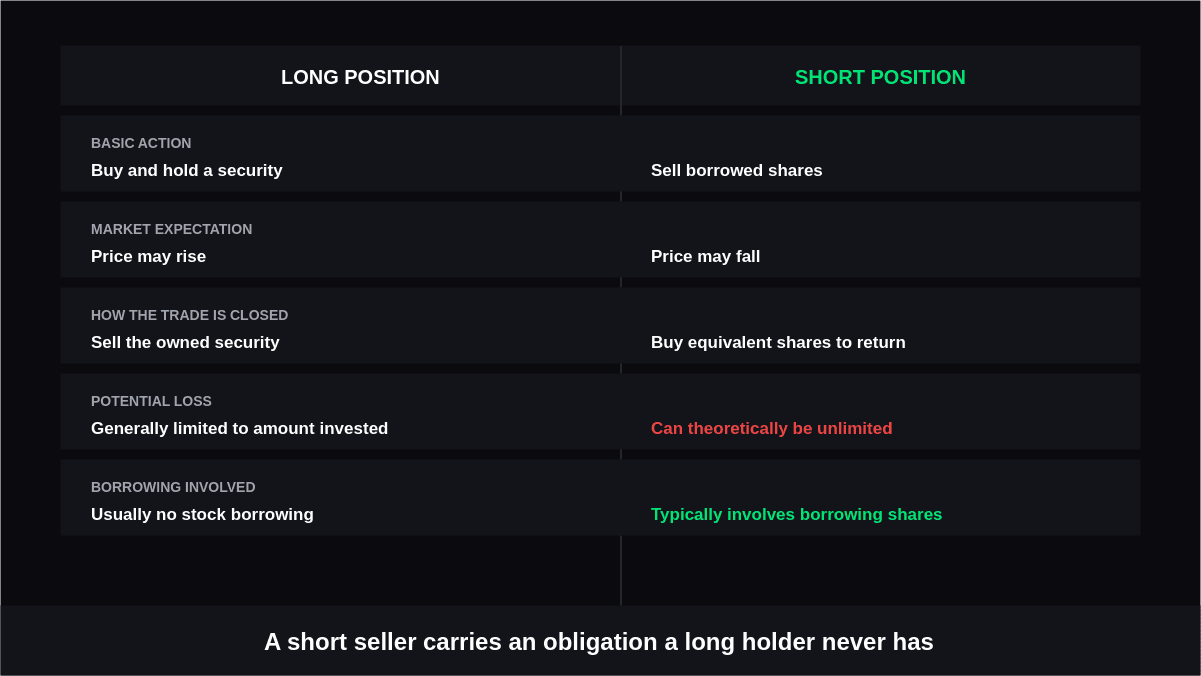
A long position and a short position create fundamentally different market exposures. With a long position, an investor owns the security and generally expects its value to increase.
With a short position, the trader has sold borrowed or otherwise non-owned shares and generally expects the price to decline.
To better understand the difference, the following comparison shows how the two approaches work:
| Factor | Long Position | Short Position |
|---|---|---|
| Basic action | Buy and hold a security | Sell borrowed shares |
| Market expectation | Price may rise | Price may fall |
| How the trade is closed | Sell the owned security | Buy equivalent shares to return |
| Potential price-based gain | Increases as price rises | Increases as price falls |
| Potential price-based loss | Generally limited to the amount invested | Can theoretically be unlimited |
| Borrowing involved | Usually no stock borrowing | Typically involves borrowing shares |
The important distinction is that a short seller has an obligation connected to the borrowed security. The position is not complete simply because the shares were sold. Equivalent securities generally need to be purchased later to close the position.
5 Things That Happen When a Short Position Is Borrowed
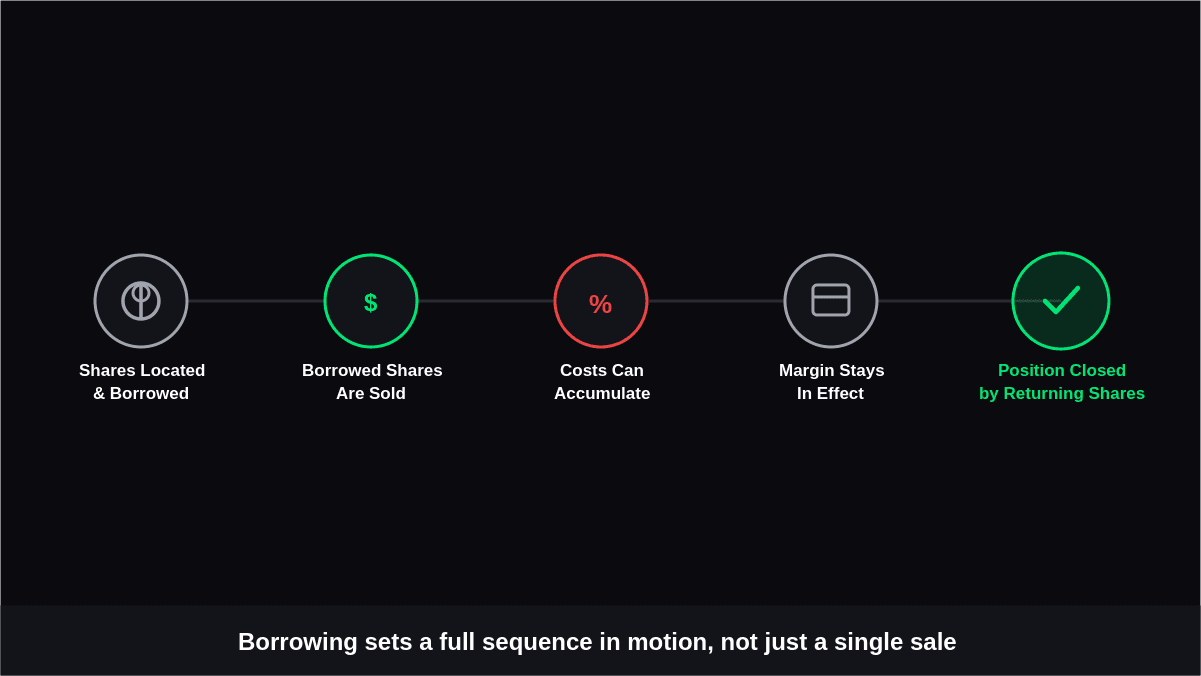
Borrowing shares sets several processes in motion. The exact arrangements can vary by broker and security, but the basic sequence involves locating shares, selling them, maintaining the position, accounting for borrowing-related costs, and eventually closing the trade.
1. Shares Are Located and Borrowed
Before a short sale can be completed, the broker generally needs to locate shares that can be delivered to the buyer. Under Regulation SHO, broker-dealers generally must have borrowed the security, entered into a bona fide arrangement to borrow it, or have reasonable grounds to believe it can be borrowed in time for delivery.
- Shares may come from the broker's own inventory.
- They may come from another customer's margin account.
- A broker may obtain securities from another lender.
- Availability can differ between securities and over time.
This is where stock borrowing becomes an important part of the short-selling process.
2. The Borrowed Shares Are Sold
Once the shares are available for the transaction, the short seller sells them in the market.
The buyer receives the shares through the normal settlement process, while the short seller retains the obligation to provide equivalent shares to the lender later.
- The original sale establishes the short exposure.
- The trader receives proceeds from the sale.
- The borrowed shares are no longer simply sitting in the trader's account.
- The trader must eventually obtain equivalent shares to close the obligation.
The short seller therefore has an open position whose value changes as the market price moves.
3. Borrowing and Other Costs Can Accumulate
Holding a short position can involve costs beyond the eventual difference between the selling and repurchasing prices. A broker may charge interest or other fees associated with borrowing the security.
- Borrowing costs can reduce a profitable trade's net return.
- Fees may vary depending on the security and lending conditions.
- Dividend-paying stocks create an additional obligation.
- The short seller generally must compensate the stock lender for dividends paid while the shares are borrowed.
This means the price movement alone does not determine the final financial result.
4. Margin Requirements Continue While the Trade Is Open
A short position is generally subject to margin requirements. As the security's price changes, the amount of equity supporting the position can change as well.
- A rising share price can increase the short seller's loss.
- Additional funds or securities may be required if account requirements are not maintained.
- A broker can impose its own requirements in addition to regulatory minimums.
- Failure to meet requirements can result in the position being closed.
This makes risk management particularly important when a borrowed position remains open during a volatile market.
5. The Position Is Closed by Returning Equivalent Shares
Eventually, the trader may decide to close the short position. This is commonly done by purchasing equivalent shares in the market and using them to satisfy the obligation to the lender.
- If the replacement shares cost less than the original sale price, the trade may produce a gain before costs.
- If they cost more, the trader realizes a loss.
- Borrowing fees and other expenses affect the final result.
- Once the borrowed shares have been returned and the position is closed, the short exposure ends.
A rapid wave of short sellers buying shares to close positions can also contribute to strong buying pressure. In some market situations, this can form part of a short squeeze, particularly when many traders are attempting to exit short positions while the price is rising.
Conditions in Which a Short Position Is Borrowed
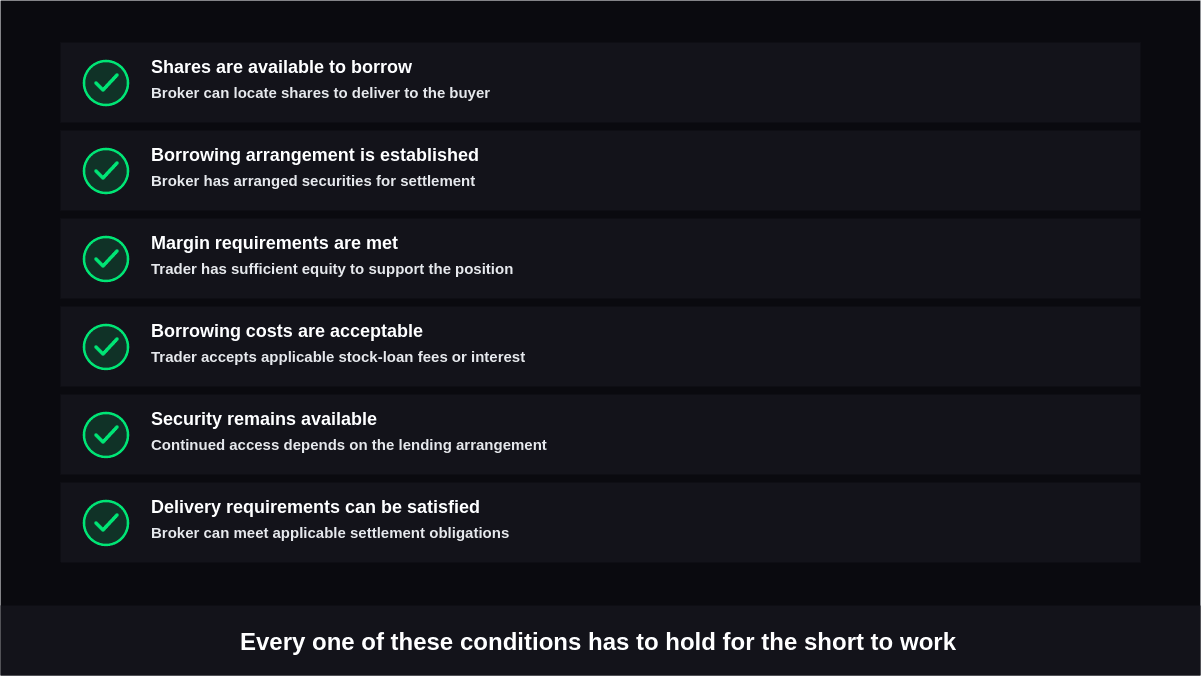
A short position generally requires shares to be available for borrowing before the short sale can proceed. The availability, cost, and terms of the borrow can vary depending on the security, broker, and current lending conditions.
| Condition | What It Means for the Short Seller |
|---|---|
| Shares are available to borrow | The broker can locate shares that can be borrowed and delivered to the buyer. |
| Borrowing arrangement is established | The broker has made the necessary arrangements to obtain the securities for settlement. |
| Margin requirements are met | The trader has sufficient account equity to support the short position under applicable requirements. |
| Borrowing costs are acceptable | The trader understands and accepts any applicable stock-loan fees or interest. |
| Security remains available | Continued access to borrowed shares may depend on the lending arrangement and broker's policies. |
| Delivery requirements can be satisfied | The broker must be able to meet the applicable settlement obligations for the short sale. |
These conditions show why short selling involves more than simply expecting a stock price to fall. The trader also needs to account for share availability, borrowing terms, and the requirements that apply while the position remains open.
Why Borrow Availability Matters to Short Sellers
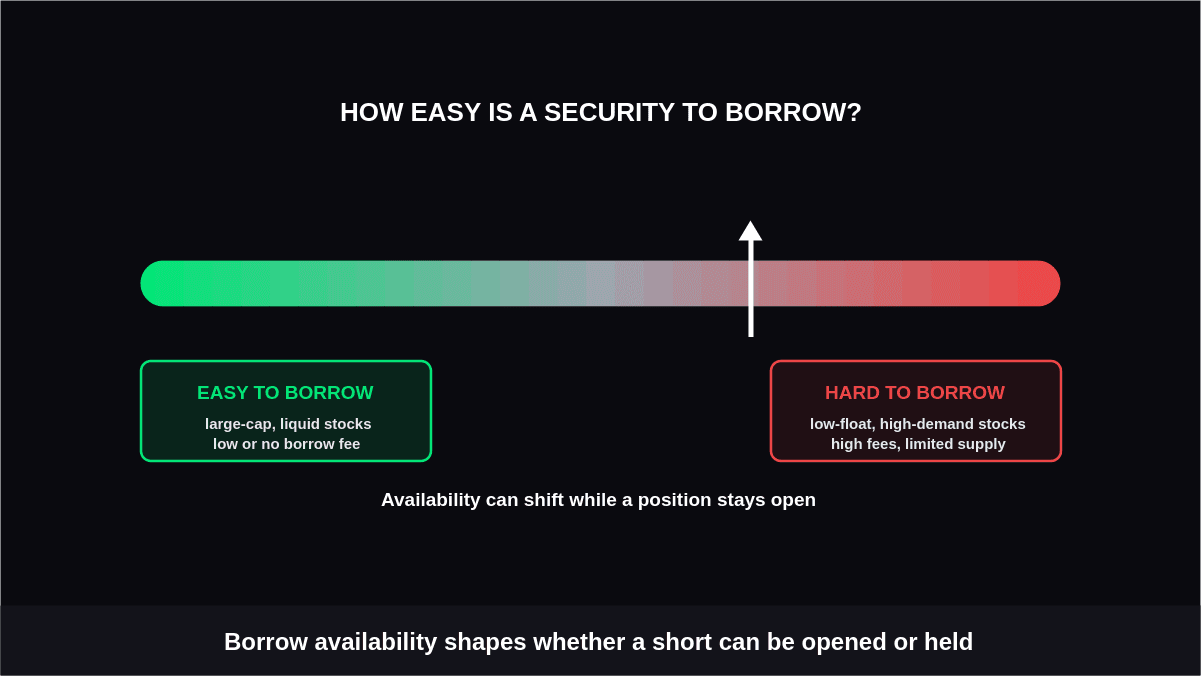
The ability to borrow shares is an important practical consideration because not every security is equally easy to borrow. A broker needs to have access to securities that can be delivered as required.
Borrowing conditions can therefore affect whether a trader can establish or maintain a particular short position. Securities lending is itself a temporary transfer of securities from a lender to a borrower, generally for a fee.
For traders, this means that a short-selling strategy involves more than identifying a stock they expect to decline. They also need to consider whether the security can be borrowed and what costs or account requirements may apply, along with factors such as the best time of day to day trade.
Conclusion
A short position built through borrowed shares creates an ongoing obligation rather than a simple one-time sale. Shares are located and borrowed, sold into the market, maintained under applicable margin and lending conditions, and eventually replaced so they can be returned to the lender.
The outcome depends on the security's price movement as well as borrowing costs, dividends, fees, and account requirements.
Understanding these moving parts helps traders distinguish the mechanics of short selling from the simpler process of buying and holding a long position.