Wyckoff Distribution is a period after a sustained uptrend where large institutional players quietly sell their positions to retail buyers. It looks bullish on the surface, but ends in a market decline. Learning to read it puts you on the right side of the trade.
You've probably been there. The market looks strong. Everyone is talking about a stock or a coin. You buy in, and within a few weeks, the price starts dropping and keeps dropping. You exit at a loss, wondering what went wrong. In many cases, what went wrong is that you were the exit liquidity. Large players needed someone to sell to, and you were available. Richard Wyckoff spent decades studying how institutional traders operate. He documented their patterns in the early 1900s, and the logic still holds because human behavior and market structure haven't changed. The Wyckoff Distribution phase is one of those patterns the one that explains how large players exit at the top. This guide walks through the full distribution model: what it is, what each event looks like, how to read volume, how to spot it on a chart, and how beginners typically get tripped up by it.
The Wyckoff Market Cycle
Before going into distribution, you need to know where it sits in the broader cycle. Wyckoff identified four phases that play out repeatedly across all markets:
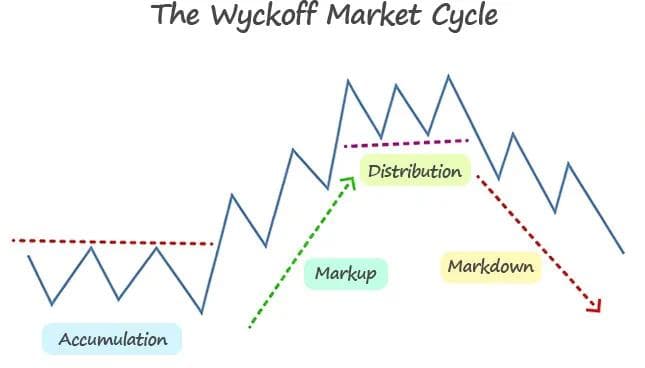
Accumulation → Markup → Distribution → Markdown
- Accumulation: Smart money buys quietly while the price is low and sentiment is negative. The public isn't interested yet.
- Markup: Price rises. The public notices and starts buying. Smart money continues to hold.
- Distribution: Price is high. Smart money sells into the retail buying frenzy. This is the phase this guide covers.
- Markdown: Selling is complete. Price drops. The public panics and sells at a loss.
Distribution sits between markup and markdown. It's the transition zone where control shifts from buyers to sellers. The problem is that it doesn't look like a top while it's happening. Price is still high, news is still positive, and retail traders are still buying. That's the entire point, smart money needs buyers on the other side of their sells.
What Is Wyckoff Distribution?
Distribution is the process through which institutional players sell large positions into a market that still has enough demand to absorb those sales without immediately crashing the price.
If a large fund tried to sell a billion dollars of stock in one order, the market impact would be severe. The price would drop sharply on the order alone. So instead, they sell over time across weeks or months into the natural buying pressure that exists at market peaks.
The result is a range-bound market at the top. Price moves sideways. Retail traders interpret every pullback as a buying opportunity and every rally as confirmation that the trend continues. Meanwhile, each rally is used to unload more supply.
Distribution ends when the sale is complete. Then the price drops often fast into markdown.
Key point: Distribution is not a single candle or a single day. It's a process that plays out over weeks or months, depending on the asset and timeframe.
The 3 Laws That Drive Distribution
Wyckoff built his method on three principles. Each one applies directly to the distribution phase.
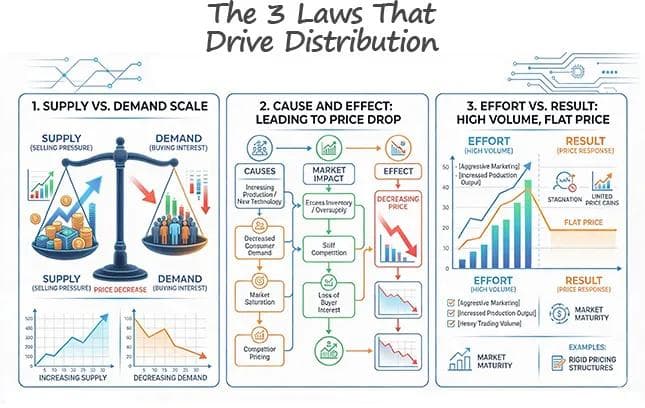
1. Supply and Demand
When supply exceeds demand, price falls. During distribution, institutions add supply to the market at every rally. As long as retail demand keeps absorbing it, the price stays range-bound. Once supply overwhelms demand, markdown begins.
2. Cause and Effect
Every significant price move has a buildup period. In distribution, the cause is the length and depth of the trading range. A longer distribution range typically leads to a larger markdown. This is why identifying the range early matters it gives you a rough sense of the move that follows.
3. Effort vs. Result
Volume is the effort. Price movement is the result. During distribution, you'll often see high volume with minimal upward price progress. A lot of effort is being put in, but the market isn't going anywhere. That tells you a large supply is being absorbed, just not yet reflected in price.
The 9 Key Events in the Wyckoff Distribution Schematic
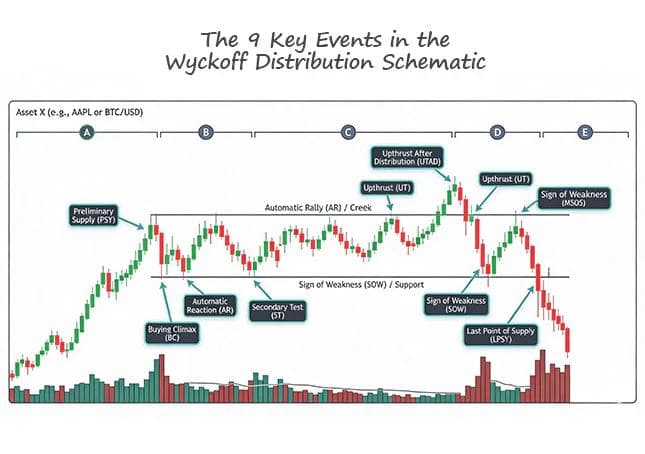
Wyckoff and later his students mapped out the distribution phase into specific events that appear in a fairly consistent sequence. You won't always see all nine, but understanding each one lets you read what the chart is telling you.
Preliminary Supply (PSY)
The first sign that selling pressure is entering the market. Price is still in an uptrend, but you start seeing unusually large volume on a down bar. Smart money is testing the market's ability to absorb supply. Most retail traders ignore this because the price hasn't reversed yet.
Buying Climax (BC)
A fast, high-volume push to a new high. This is the final wave of retail buying, often driven by FOMO and positive news. Smart money uses this surge in demand to unload large positions. The BC usually marks the highest point in the entire distribution range.
Automatic Reaction (AR)
After the BC, buying pressure dries up, and the price drops sharply. No major catalyst is required; the demand simply runs out. The AR low establishes the bottom of the distribution range. Together, the BC high and the AR low define the boundaries you'll be working within.
Secondary Test (ST)
Price rallies back toward the BC high, but on lower volume and with less momentum. It fails to reach or exceed the BC. This confirms the BC high as resistance. A weak ST is one of the earliest signs that supply is in control.
Upthrust (UT)
A brief move above the resistance level, the BC high, that fails to hold. Price pushes above the range, traps breakout buyers, then reverses back inside. Volume on the UT is often high initially, but the bar closes near or below resistance. High volume with no follow-through means the breakout was absorbed, not genuine. This is a common entry point for traders who understand the pattern.
Upthrust After Distribution (UTAD)
A more aggressive false breakout that happens later in the range, after Phase B has played out. It serves the same purpose as a UT but occurs deeper into the structure. It traps the remaining bulls and gives smart money a final opportunity to sell at elevated prices before the real break begins.
Sign of Weakness (SOW)
A notable decline that breaks below the AR low, or moves forcefully through the lower part of the range on increased volume. This is the market showing its hand; supply is clearly in control. Price may recover temporarily, but the SOW signals the structure is breaking down.
Last Point of Supply (LPSY)
After the SOW, price attempts a weak rally. Volume is low. The rally fails to reach previous highs and forms a lower high. This is the final chance for remaining smart money to exit their positions. LPSY often forms below the midpoint of the old range, which is itself a structural shift from where the earlier rallies peaked.
Major Sign of Weakness / Range Break (MSOS)
Price breaks decisively below the support level of the distribution range. This confirms that markdown has begun. Any subsequent bounce that fails to reclaim the old support now treats that level as resistance. This creates a second entry opportunity for traders who missed the initial break.
Beginner tip: You don't need to identify every event in real time. Focus on finding the BC high and the AR low first, which defines your range. Then watch for UTs and SOWs to confirm the pattern is developing.
The 5 Phases of Distribution
The nine events above are grouped into five phases. Think of the phases as chapters, and the events as the scenes within them.
Phase A (The Uptrend Ends): Selling pressure appears for the first time. The BC high and AR low establish the boundaries of the range. The ST confirms resistance. Most traders still think the uptrend is intact.
Phase B (Building the Cause): Price oscillates within the range. Smart money continues selling into rallies. Multiple secondary tests and upthrusts appear. Volume is irregular. This phase can last the longest and is where most beginners mistakenly re-enter long.
Phase C (The Trap): A final false breakout above the UTAD traps late buyers. This is often the last high in the range before the breakdown. It's designed to look like a genuine breakout so that retail traders buy in, giving smart money one last group of buyers to sell to.
Phase D (Supply Takes Control): The SOW and LPSY confirm that the structure has shifted. Lower highs form on weak rallies. Volume expands on down moves and dries up on rallies. The trend is now clearly bearish within the range.
Phase E (Markdown Begin): Price breaks below the support level of the range. The MSOS confirms the breakdown. Any retest of the broken support that fails is a second entry opportunity for short trades.
How to Read Volume During Distribution
Volume is not optional in the Wyckoff method. It's the primary tool for confirming what price action is suggesting.
On rallies: Volume should decline. If the price is going up but with decreasing volume, it means demand is thinning. Smart money is not supporting the rally; they're selling into it.
On declines: Volume should increase. When the price drops on heavy volume, significant supply is hitting the market.
On upthrusts: Volume is often high initially, that's the breakout buyers coming in, but the bar closes back inside the range. High volume with no follow-through equals absorption, not strength.
On LPSY: Volume dries up significantly. The rally has no participation. This confirms that smart money is done distributing and has no interest in supporting higher prices.
Watch out: If rallies within the range are occurring on heavy volume, you may not be looking at distribution. You may be looking at an accumulation or a continuation pattern. Volume behavior is what separates the two. Don't skip it.
Distribution vs. Accumulation: How to Tell the Difference
Both distribution and accumulation create range-bound markets. They look similar on the surface. The differences are context and volume behavior.
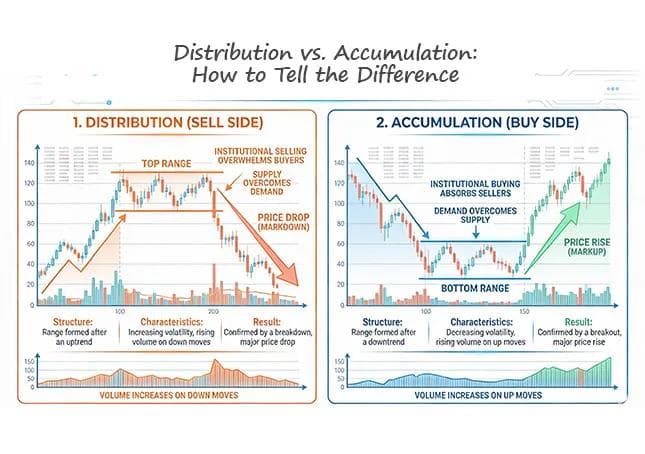
| Signal | Distribution | Accumulation |
|---|---|---|
| Comes after | A sustained uptrend | A sustained downtrend |
| Smart money is | Selling into retail buying | Buying from retail sellers |
| Volume on rallies | Decreasing / weak | Increasing / strong |
| Volume declines | Increasing / heavy | Decreasing / light |
| False breakout direction | Above resistance (UT / UTAD) | Below support (Spring) |
| What follows | Markdown: price falls | Markup: price rises |
The trend preceding the range is your first filter. If the price has been rising for a significant period before entering a sideways range, lean toward distribution. If it's been falling, lean toward accumulation. Then confirm with volume.
Does Wyckoff Distribution Work in Crypto?
Yes, with some caveats. The Wyckoff method applies across any liquid market stocks, crypto, forex, commodities, and futures. The underlying logic doesn't change because the behavior driving it doesn't change. Large players need to distribute their holdings, and they do it the same way regardless of the asset.
Crypto analysts regularly annotate Wyckoff distribution phases on Bitcoin and Ethereum charts. The major crypto drawdowns of 2018 and the 2021-2022 collapse showed distribution characteristics before the markdowns began. Clear BC highs, UTAD-style false breakouts, and volume divergence were all visible in hindsight and, for those watching carefully, in real time.
The caveat: stick to liquid assets. On small-cap altcoins with low trading volume, Wyckoff patterns are less reliable. The volume data is thin and easier to distort. A single large player can manipulate the signals. Use Wyckoff on assets where there's genuine institutional participation: BTC, ETH, large-cap stocks, major forex pairs.
Common Mistakes Beginners Make
There are a few mistakes that beginners make:
Calling the top too early. Any minor pullback in an uptrend can look like the start of distribution if you're looking for it. Wait for the full BC and AR structure to form before committing to the label.
Ignoring volume. Pattern matching on price alone leads to a high rate of false reads. Volume confirms or denies everything in the Wyckoff method. Never skip it.
Confusing redistribution with distribution. During a downtrend, the price sometimes pauses in a sideways range before continuing lower. That's redistribution, a pause mid-fall, not a major top. Context matters. Always check what happened before the range.
Looking at the wrong timeframe. A distribution range on a 15-minute chart has very different implications than one on a weekly chart. Always check a higher timeframe for context before acting on a lower-timeframe pattern.
Entering too early. Waiting for the SOW or MSOS before committing to a short trade is frustrating but necessary. The UTAD can fool you into thinking distribution is complete when Phase B is still playing out.
Using Wyckoff on illiquid assets. On low-volume assets, volume signals are unreliable. The method works where institutions are active, and the volume of data is trustworthy.
How to Trade the Wyckoff Distribution (Basic Framework)
There are two main entry points Wyckoff traders watch for.
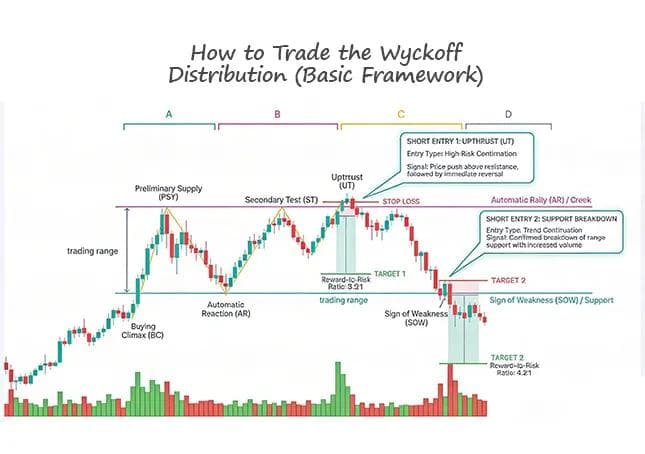
Entry 1: The Upthrust / UTAD
When price pushes above resistance and quickly reverses back inside the range, that's a shorting opportunity. You're entering near the high of the range with a clearly defined stop above the UT or UTAD high. If the distribution is valid, the price won't reclaim that level. Risk is defined, and you're positioned before the major break.
Entry 2: The MSOS / Range Break
When the price closes below the support level of the distribution range on increased volume, that's the confirmation entry. It's more conservative and slightly later, but has a higher probability because the structure has already broken. If price retests the broken support from below and fails to hold it, that's a third entry, often called the back-to-ice retest.
Stop placement: Above the UT or UTAD high for Entry 1. Above the LPSY high for Entry 2.
Target: Prior demand zones below the range. A rough target can also be calculated by projecting the height of the distribution range downward from the break point.
Confirmation needed: Volume expansion on the breakdown, and weak, low-volume rallies after the break. If you see strong volume on a bounce after the MSOS, reassess.
Risk management: Never risk more than 1–2% of your account on a single trade, regardless of how confident you are in the setup. Even the clearest distribution pattern can fail. A UT can become a genuine breakout. Protect your capital first.
Quick-Reference Glossary
PSY, Preliminary Supply: First significant selling after an uptrend. Volume spikes on a down bar.
BC, Buying Climax: Final high-volume push to a new high. Marks the top of the range.
AR, Automatic Reaction: Sharp pullback after the BC. Sets the bottom of the distribution range.
ST, Secondary Test: Weak rally back toward the BC high. Confirms resistance on declining volume.
UT, Upthrust: False breakout above range resistance that quickly reverses back inside.
UTAD, Upthrust After Distribution: Later-stage false breakout that traps the remaining bulls before markdown.
SOW, Sign of Weakness: Significant decline through or below the range of heavy volume.
LPSY, Last Point of Supply: Final weak rally before markdown. Volume is light, highs are lower.
MSOS, Major Sign of Weakness: Decisive break below range support. Confirms markdown has begun.
Composite Man: Wyckoff's mental model for the collective behavior of large institutional players.
Markdown: The sustained downtrend that follows a completed distribution range.
Redistribution: A sideways range that forms during a downtrend before the price continues lower. Not a major top.
Conclusion
The Wyckoff Distribution model doesn't predict the future. What it does is give you a framework for reading what has already happened, and that's enough to put you ahead of most retail traders. The core idea is simple. After a long uptrend, smart money sells into the buyers who show up late. That selling doesn't happen in one candle. It happens across a range, and that range has a structure with identifiable events. You don't need to label every event on every chart. Start by finding the BC high and AR low to define your range. Then watch for upthrusts and volume behavior to tell you whether supply or demand is in control. Study enough charts, and the pattern becomes familiar.
At Gainzalgo, we break down exactly these kinds of frameworks, the ones that actually change how you read a chart. The goal isn't to short every distribution you think you see. The goal is to stop being the buyer at the top.
FAQs
How is Wyckoff Distribution different from a normal pullback?
A pullback recovers quickly with strong volume. Wyckoff Distribution is a multi-week process where rallies repeatedly fail at resistance on low volume, and declines come on heavy volume.
How long does a distribution phase typically last?
Anywhere from a few weeks on a daily chart to over a year on a weekly chart. Longer ranges typically lead to deeper markdowns.
What is the safest entry point for a short trade in a distribution setup?
The MSOS, the break below range support. Even safer is waiting for the price to retest that broken support from below and fail to reclaim it.
Where should I place my stop-loss in a distribution trade?
Above the UT or UTAD high for early entries. Above the LPSY high for MSOS entries. If price reclaims those levels on volume, exit; the setup has failed.
Can I use Wyckoff Distribution to time long exits, not just short entries?
Yes, and for most retail traders, this is the more practical use. Spotting a BC and a failed Secondary Test is a clean signal to reduce or close long positions before the breakdown.
How do I set a price target after the distribution range breaks down?
Look for prior demand zones below the range, or subtract the range height (BC high to AR low) from the breakout point as a rough projection.
What is redistribution and how do I avoid confusing it with distribution?
Context. Distribution follows an uptrend. Redistribution is a pause mid-downtrend before price continues lower. Always check the higher timeframe before labeling a range.
What happens if an Upthrust turns into a genuine breakout?
Exit. A genuine breakout holds above resistance with expanding volume and follow-through. Your stop above the UT high handles it automatically, don't fight it.
Which timeframes work best for identifying Wyckoff Distribution?
Daily and weekly charts give the most reliable signals. Use them to identify the structure, then drop to a lower timeframe to time entries.
Is Wyckoff Distribution a guaranteed predictor of a market crash?
No. It's a probabilistic framework. Patterns fail. The edge comes from combining structure, volume, defined stops, and disciplined risk management — not from certainty.