Sharp price movements can create difficult trading conditions, particularly when a stock moves rapidly within a short period. The Limit Up and Limit Down Rule is designed to help moderate these extreme moves by restricting trades outside defined price bands.
Instead of allowing an individual stock to continue moving without a temporary boundary, the system establishes upper and lower limits based on recent trading activity.
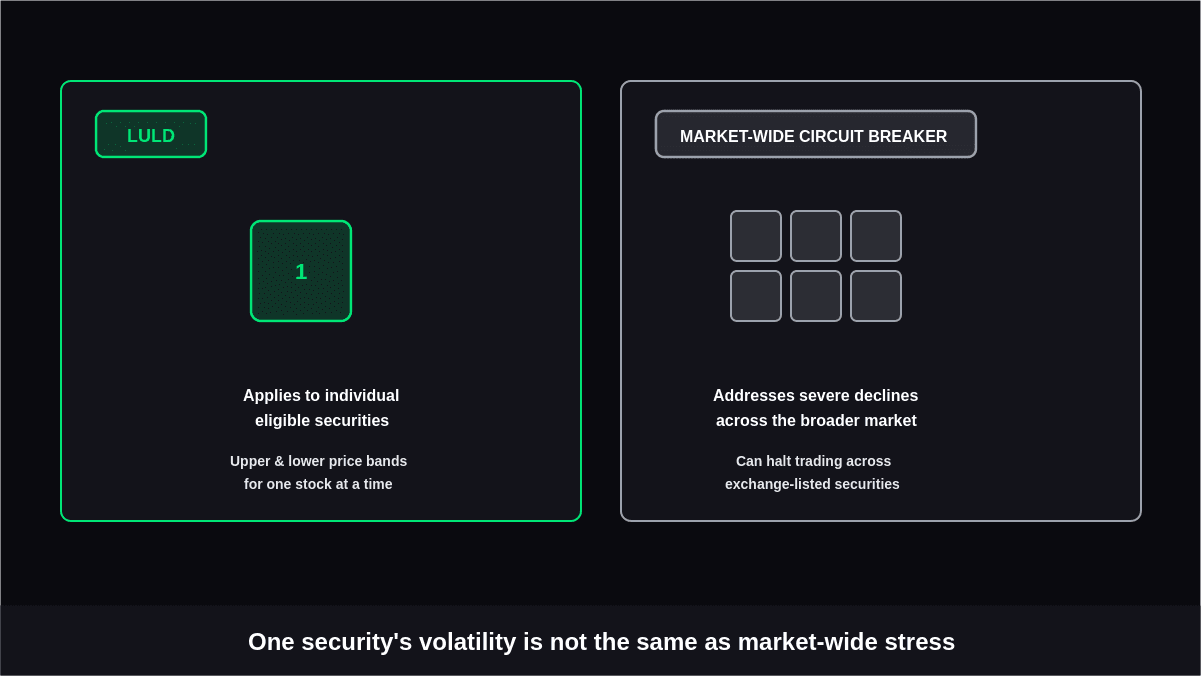
The rule is part of the U.S. equity market's broader approach to handling extraordinary volatility. The Limit Up-Limit Down, or LULD, mechanism applies to individual securities and is different from market-wide circuit breakers, which can halt trading across the broader market.
The SEC describes LULD as a mechanism intended to prevent trades in individual securities from occurring outside specified price bands, making it relevant to how Trading Halts can affect market activity.
In this blog, we will explore what the Limit Up and Limit Down Rule means, how each side works, and why traders should understand the difference. We will also look at the situations that can lead to a trading pause and the practical distinctions between the two limits.
What Does the Limit Up and Limit Down Rule Mean?
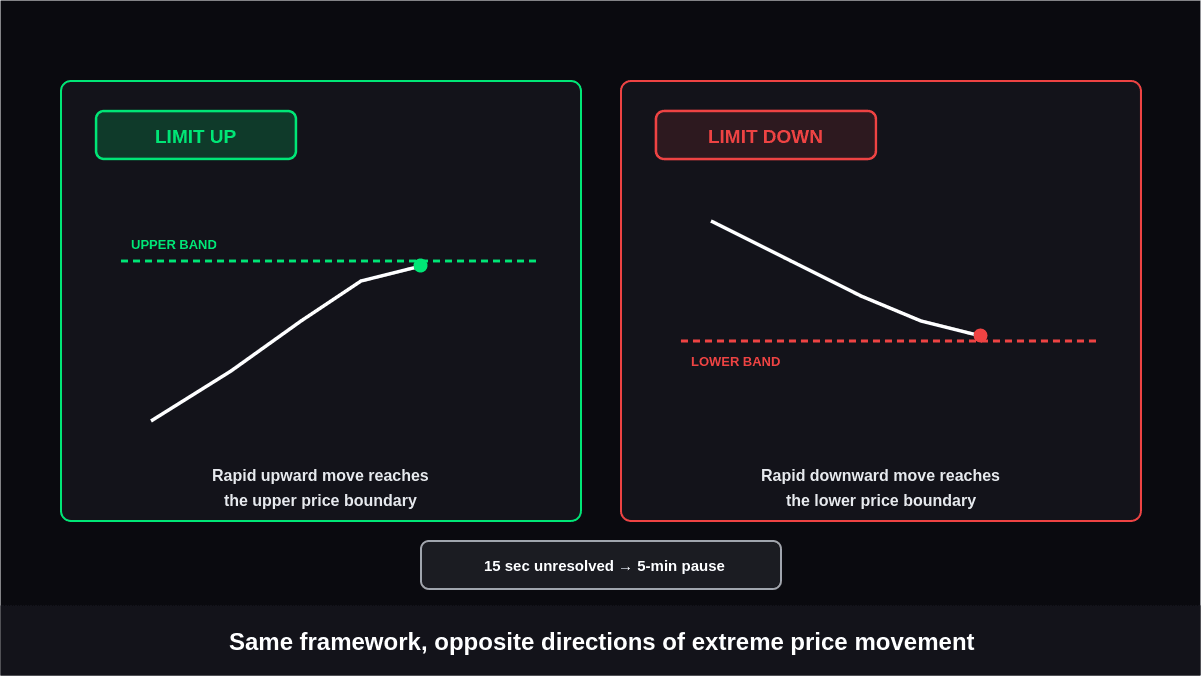
The Limit Up and Limit Down Rule creates an upper and lower price boundary around an individual stock's recent reference price. Trades generally cannot occur outside those boundaries while the LULD mechanism is active.
The reference price is based on recent trading information, and the applicable percentage depends on the security's classification and price. If trading reaches one of these boundaries and conditions persist, the security can enter a limited state or eventually experience a temporary trading pause.
Limit Up Rule
A limit up occurs when upward price movement reaches the upper boundary established by the applicable LULD price bands. The purpose is not to prevent a stock from ever rising further. Instead, it establishes a temporary boundary for executions during unusually rapid movement.
Key points include:
- The upper price band establishes the maximum permitted execution level under the LULD mechanism.
- A stock can enter a limit state when its national best offer reaches the lower or upper boundary conditions specified by the plan, depending on market direction.
- If the market returns within the applicable bands, normal trading conditions can resume.
- If the security remains in a qualifying limit state for 15 seconds, a five-minute trading pause can occur.
- The applicable percentage band varies according to the security and its price.
For traders, the important point is that a rapid upward move can encounter a predefined boundary rather than continuing to execute at increasingly higher prices without restriction.
Limit Down Rule
A limit down applies when a stock experiences an unusually rapid downward movement toward its lower price boundary. The lower band establishes the point below which trades cannot generally execute while the applicable LULD conditions are in effect.
Important characteristics include:
- The lower price band creates a temporary floor for eligible executions.
- A security can enter a limit state when market quotations reach the relevant boundary.
- The reference price can remain fixed during a limit state while the market attempts to return within the permitted range.
- If the qualifying condition is not resolved within 15 seconds, trading can pause for five minutes.
- Trading can subsequently reopen through an auction process.
A limit down therefore deals with rapid downward pressure, while limit up addresses the opposite direction.
Limit Up vs Limit Down Rule
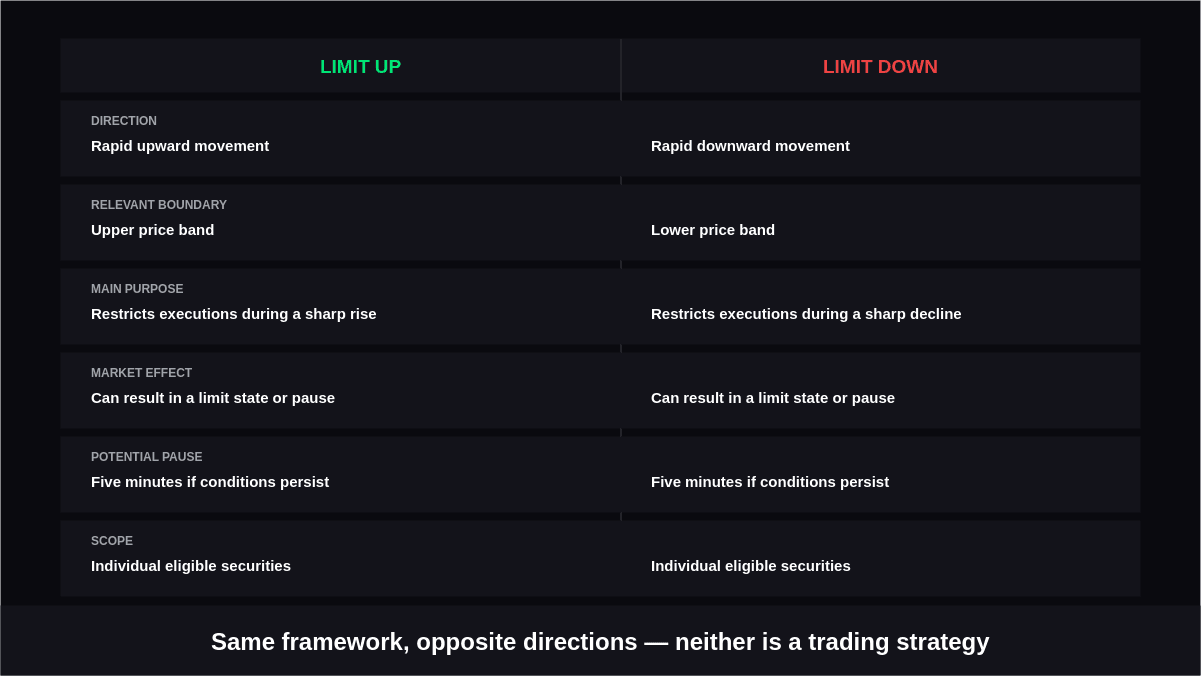
Although both mechanisms belong to the same LULD framework, they address opposite directions of extreme price movement. The difference is primarily the side of the permitted price range being approached.
The following table highlights the main distinctions without treating either mechanism as a separate trading strategy.
| Feature | Limit Up | Limit Down |
|---|---|---|
| Direction | Rapid upward movement | Rapid downward movement |
| Relevant boundary | Upper price band | Lower price band |
| Main purpose | Restricts executions during an unusually sharp rise | Restricts executions during an unusually sharp decline |
| Market effect | Can result in a limit state or trading pause | Can result in a limit state or trading pause |
| Potential pause | Five minutes if qualifying conditions persist | Five minutes if qualifying conditions persist |
| Reference framework | Upper LULD price band | Lower LULD price band |
| Scope | Eligible individual stocks reaching the upper price band | Eligible individual stocks reaching the lower price band |
Both sides are therefore designed around the same volatility-moderation framework. They differ in the direction of the price movement that brings the security toward the relevant boundary.
Key Differences You Must Know
Understanding the terminology is useful, but traders also need to know how these mechanisms differ in practical market situations. The following distinctions explain what changes depending on whether the market is moving sharply higher or lower.
1. Direction of Price Movement
The most straightforward difference is the direction in which the stock is moving.
Limit up:
- Applies to an unusually rapid upward move.
- Involves the upper side of the applicable price range.
- Can restrict further executions above the established boundary.
Limit down:
- Applies to an unusually rapid downward move.
- Involves the lower side of the applicable price range.
- Can restrict executions below the established boundary.
This directional distinction is the foundation for understanding the two terms.
2. Upper Boundary vs Lower Boundary
The two mechanisms use opposite sides of the permitted trading range.
For limit up:
- The upper price band establishes the relevant ceiling.
- Buyers may encounter the boundary during a sharp price increase.
- The market must remain within the applicable LULD framework for executions to continue normally.
For limit down:
- The lower price band establishes the relevant floor.
- Sellers may encounter the boundary during a rapid decline.
- The same volatility-control framework applies from the opposite direction.
The boundaries are calculated using the applicable LULD methodology rather than a fixed dollar amount for every stock.
3. Different Market Pressures
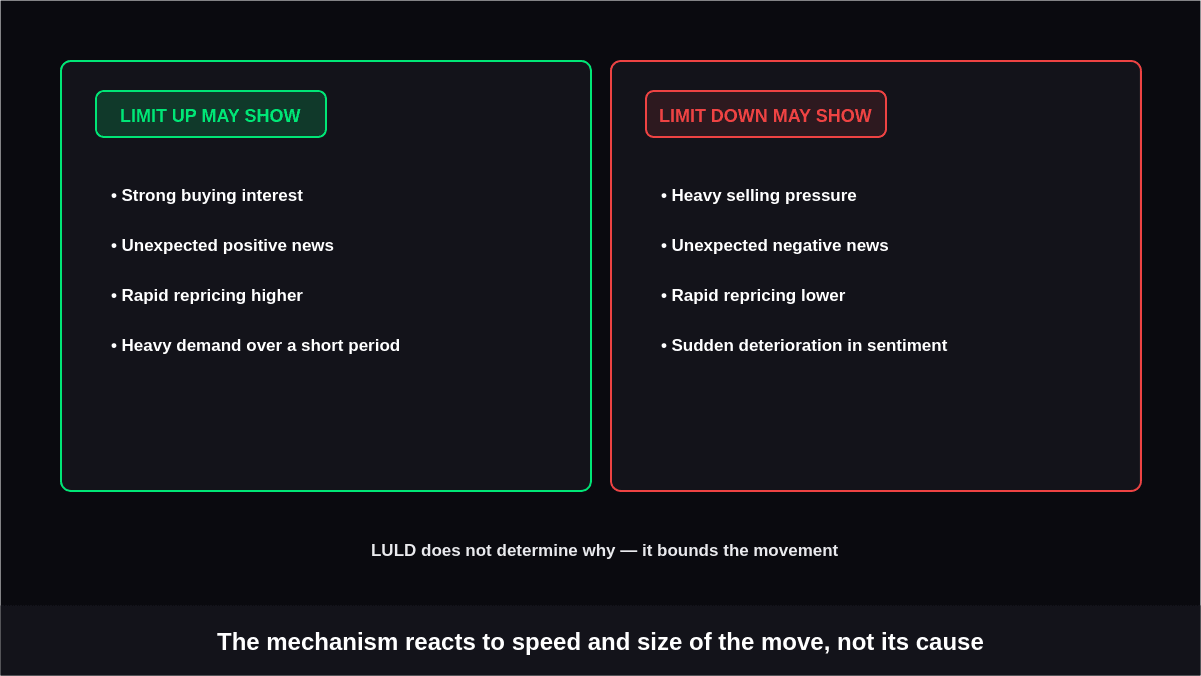
Limit up and limit down can reflect different types of short-term market pressure.
Limit up may occur alongside:
- Strong buying interest
- Unexpected positive company news
- A rapid repricing of the security
- Heavy demand over a short period
Limit down may occur alongside:
- Heavy selling pressure
- Unexpected negative company news
- A rapid repricing lower
- A sudden deterioration in market sentiment
The LULD mechanism itself does not determine why a stock is moving. It establishes boundaries around the movement.
4. Trading Pause Conditions
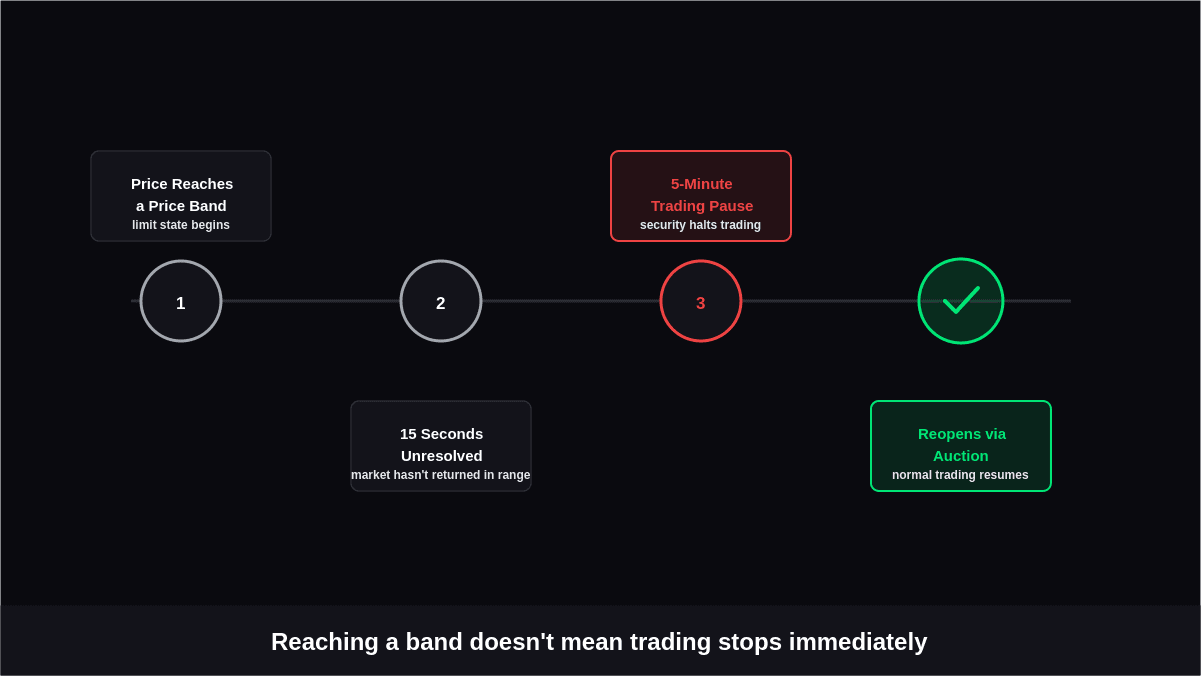
Both directions can lead to a stock trading halt, but the pause is a consequence of the LULD conditions rather than a separate type of rule.
If a qualifying limit state is not resolved within 15 seconds, trading can pause for five minutes. After the pause, trading can reopen through an auction.
This distinction matters because reaching a price band does not automatically mean that trading will stop immediately. The market can potentially return within the permitted range before a pause occurs.
5. Relationship With Market-Wide Circuit Breakers
LULD should not be confused with market-wide circuit breakers.
LULD:
- Applies to individual eligible securities.
- Establishes upper and lower price bands.
- Addresses extraordinary volatility in a particular security.
Market-wide circuit breakers:
- Address severe declines affecting the broader U.S. market.
- Can halt trading across exchange-listed securities when specified market-level thresholds are reached.
The SEC distinguishes the individual-security LULD mechanism from market-wide circuit breakers.
Why the Limit Up and Limit Down Rule Matters to Traders
The rule matters because extremely fast price movements can create execution conditions that differ from ordinary trading. A stock may move rapidly enough that displayed prices and available liquidity change in a very short period.
The LULD framework provides a mechanism for moderating those movements without automatically treating every sharp price change as a reason to stop the entire market.
It operates at the individual-security level and provides defined boundaries that trading venues must respect, offering useful Trading Strategy Benchmarks when evaluating how trading rules respond to sudden price movements.
For traders, understanding these rules can also make unusual market behavior easier to interpret.
Seeing a stock approach a price band, enter a limit state, or temporarily pause does not necessarily mean the company's long-term fundamentals have changed. It can simply indicate that the security is experiencing significant short-term volatility.
Conclusion
The Limit Up and Limit Down Rule is an important part of the U.S. market's framework for managing extraordinary volatility in individual securities. Limit up addresses rapid movement toward an upper price boundary, while limit down addresses movement toward a lower boundary.
Under the LULD system, qualifying conditions can lead to a temporary trading pause if the market does not return within the permitted range.
Understanding these distinctions can help traders interpret unusual price action more accurately and recognize why an individual stock may temporarily stop trading.
The key is to distinguish LULD price bands from broader market-wide circuit breakers and to understand that the mechanism is a volatility-control framework rather than a prediction of where a stock will move next, unlike the signals provided by technical indicators.